

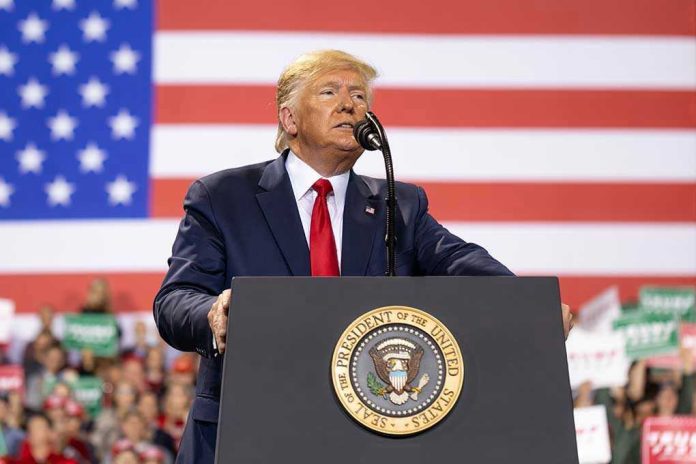
Georgia has become the place where Trump fuses one combustible message—“they cheated”—with a second one voters actually feel: prices, jobs, and tariffs.
Story Snapshot
- Trump stopped in Georgia and revived his 2020 election fraud claims, calling Democrats “cheating like dogs.”
- He pointed to a recent FBI raid on Fulton County election offices as proof of “crooked ballots,” even as outcomes remain unresolved.
- The trip doubled as an economic pitch at Coosa Steel Corporation, where he praised tariffs and claimed inflation is solved.
- Georgia Republicans want a midterm boost, but party insiders disagree on whether relitigating 2020 helps win persuadable voters.
A Georgia Stop That Was Never Just a Photo Op
Trump’s Georgia visit ran like a two-act play: grievance in the morning, economics in the afternoon, with both acts aimed at the same audience—Republicans deciding what message wins the next election. He spoke first at a local restaurant, then later at Coosa Steel Corporation. The setting mattered. Georgia is central to his “stolen election” narrative, and the state also sits at the crossroads of manufacturing politics, where tariffs can feel like protection or punishment.
Trump’s core claim didn’t hide behind euphemism. He accused Democrats of cheating in 2020 and framed recent federal activity in Fulton County as confirmation. That specific hook—the FBI raid—gave his rhetoric a fresh prop, even though a raid itself proves only that investigators sought evidence, not that wrongdoing occurred. The politics are obvious: a live investigation sustains attention, and attention drives turnout. Turnout, in Trump’s world, is leverage.
The Fulton County Raid: Evidence, Theater, or Both?
Fulton County has long served as the symbol in Republican grassroots storytelling: big city, Democratic stronghold, and therefore suspect. Trump leaned hard into that symbolism by citing the FBI raid on county election offices and suggesting it unearthed “crooked ballots.” The reality presented in reporting is narrower: agents seized ballots and records tied to alleged 2020 “defects” described in an affidavit. That word—defects—invites interpretation, and interpretation is where politics rushes in.
Common sense says this is where disciplined leaders separate process from proof. Investigations matter, chain-of-custody matters, and election systems should withstand audits without public confidence collapsing. Conservatives rightly demand clean voter rolls, clear rules, and enforceable ID standards; those are policy questions. But treating an ongoing probe as a verdict risks backfiring if results don’t match the hype. It can also hand Democrats an opening to say Republicans only trust outcomes when they win.
The Voter ID Thread Trump Keeps Pulling
Trump’s push for voter ID landed as the most actionable part of the speech. Unlike sprawling claims about 2020, voter ID is concrete: show a document, verify eligibility, reduce loopholes, move on. Many Americans—especially older voters—see ID as normal life, not oppression. The catch is federalism. States run elections, and any executive-order talk faces limits, lawsuits, and questions about what Washington can command versus what it can incentivize.
The strategic lesson is simple: Republicans gain ground when they argue for rules that most people already follow in banking, air travel, and everyday commerce. They lose ground when the argument shifts from “secure future elections” to “prove the past was stolen” without publicly persuasive evidence. That’s why some Georgia Republicans want the party to talk about paychecks and affordability rather than replay 2020. They aren’t conceding principle; they’re counting votes.
Coosa Steel, Tariffs, and the Manufacturing Story Voters Understand
At Coosa Steel, Trump pivoted to economics, praising tariffs and pointing to manufacturing as a national strength. That message has an intuitive appeal for conservatives: protect domestic industry, reduce dependence on rivals, and reward work that builds tangible things. The complication is the balance sheet. Reporting cited bank research that midsize business tariff costs tripled. That doesn’t negate benefits to particular plants, but it does describe a broader squeeze that can hit suppliers and customers.
Trump also criticized the Supreme Court on emergency powers, a reminder that trade policy often rides on legal theories most voters never asked for. Conservatives usually prefer durable laws over emergency shortcuts, even when the policy outcome feels satisfying. If tariffs require legal contortions, courts can unwind them, and uncertainty punishes investment. The strongest pro-manufacturing case is the boring one: clear statutory authority, stable rules, and a tax-and-regulation environment that lets American firms compete without constant courtroom roulette.
Republicans Want a Midterm Boost, but They Don’t Agree on the Fuel
The timing of the visit tied directly to electoral math. Georgia Republicans face a special election in a district once represented by Marjorie Taylor Greene, who resigned after feuding with Trump. That local drama matters because it exposes a national problem: coalitions win elections, factions lose them. Trump energizes a base that delivers margins, but intra-party fights can drain focus and money. Some local leaders argued the economy is the winning issue and want the party to move forward.
Geoff Duncan, the former Republican lieutenant governor of Georgia, offered the sharpest contrast by accusing Trump of lying and cheating to overturn the 2020 result and urging Republicans to dump him and focus on policy. That critique won’t move Trump’s loyalists, but it signals a real split: one camp wants the party to prosecute grievances; the other wants to prosecute a case for governing. Midterms usually reward the side that looks steadier.
President Trump Goes Off on Cheating Democrats in Fiery Georgia Speech (VIDEO) https://t.co/vx80UwQ2Ko #gatewaypundit via @gatewaypundit
— Bill Seale (@seale_bill) February 20, 2026
Georgia is the preview of what’s coming: a Republican message that can either weld election integrity to practical reforms, or melt back into performance that persuades only the already-convinced. The open question isn’t whether Trump can fill a room; he can. The question is whether the movement can convert heat into light—policy clarity, legal durability, and a focus on the next win instead of the last loss.
Sources:
Trump visits Georgia, a target of his election falsehoods, as Republicans look for midterm boost