

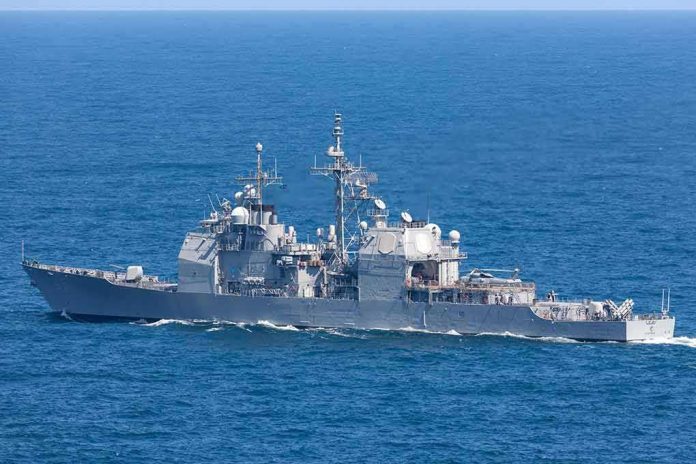
U.S. Central Command says it struck roughly 170 Iranian targets in two days to protect shipping lanes, as Iran reports casualties and vows to control the strait.
Story Snapshot
- CENTCOM reports strikes on July 7 and 8 against Iranian naval and air defenses
- Targets included small boats, radar sites, and weapons storage tied to maritime threats
- Military says President Trump ordered action to defend freedom of navigation
- Iran reports deaths and injuries and signals tighter control of shipping routes
What The U.S. Military Says It Hit And Why It Mattered
U.S. Central Command (CENTCOM) said forces hit more than 80 targets on July 7, including over 60 Islamic Revolutionary Guard Corps small boats, coastal radar, and air defenses. The next day, it reported about 90 more targets, striking missile and drone storage, naval gear, and logistics hubs. Commanders said the goal was to cut Iran’s ability to threaten ships and to punish attacks on civilian crews moving through international waters in the Strait of Hormuz.
CENTCOM linked the two days of strikes to three earlier attacks on commercial vessels. The military named the M/T Al Rekayyat, the M/T Wedyan, and the M/T Cyprus Prosperity, flagged to the Marshall Islands, Saudi Arabia, and Liberia. Officials framed the response as necessary to keep trade moving and to stop follow-on attacks. They said the operation aimed to “impose heavy costs” for targeting mariners who were not part of any fight.
Who Gave The Order And How Allies Reacted
CENTCOM said President Donald Trump directed the July 8 action after the first day of strikes. The command described the mission as a continued push to protect freedom of navigation in a key chokepoint for global oil. NATO’s top official publicly backed the response, calling it “absolutely necessary.” That support signaled allied concern about shipping risks and energy shocks if the strait becomes a shooting gallery for missiles and naval drones.
Military statements also cited Iran’s alleged violation of a mid-June memorandum meant to cool the fight at sea. The U.S. releases did not include the agreement’s full terms or verification details. That gap leaves questions about what each side promised and how either side would measure compliance. Without text or third-party checks, the public debate leans on official claims and media summaries rather than shared documents.
What Iran Claims And The Human Cost In Play
Iranian state-linked reports said the U.S. strikes caused casualties, listing 14 dead and 78 wounded across several locations. Those reports cast the attacks as violations of both a ceasefire understanding and the United Nations Charter. Iran also signaled tighter control in and near the Strait of Hormuz, warning ships to use routes it designates. These claims highlight a sharp risk to crews, ports, and energy prices if control of the sea lane becomes a tool of pressure.
U.S. Central Command announced that American forces have initiated an expanded wave of precision airstrikes against military installations inside Iran under direct presidential authorization. The official statement confirmed that the targeted operations are designed to degrade… pic.twitter.com/kF0UERLi52
— X-K (@ConflictRadarME) July 8, 2026
Independent proof remains thin in the open record. U.S. releases detail targets and name attacked ships, but offer no shared video or forensic files. Media reports cite rising oil prices and market losses after the strikes, adding economic stakes to the tension. This cycle, where one attack prompts fast retaliation, fits years of back-and-forth at the strait. It also feeds a view, held by many Americans, that leaders fight first and verify later, while families pay higher bills.
Sources:
instagram.com, centcom.mil, youtube.com