

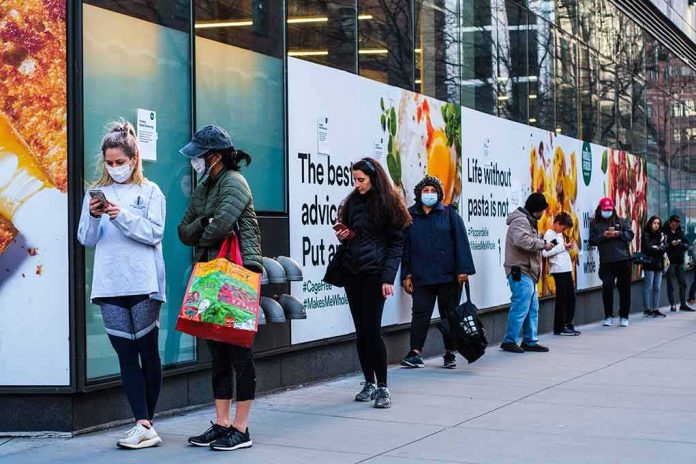
New York City is about to open taxpayer-funded grocery stores with 30% discounts for everyone—yet a fierce fight has erupted over whether you’ll need an ID to walk in and who really benefits from the deal.
Story Snapshot
- The city plans five municipal grocery stores offering about 30% off key food items, open to all shoppers regardless of income.
- Critics claim weak or nonexistent ID rules will let undocumented immigrants and non-residents tap into taxpayer-funded discounts without checks.
- Mamdani’s team now insists no one will be asked for ID, saying any card will be a voluntary savings program, not an identity screen.
- The clash reflects a deeper anger on both right and left that government programs are vague, politicized, and designed more to score points than to clearly serve working Americans.
What Mamdani’s City Grocery Plan Actually Does
New York City Mayor Zohran Mamdani has directed city money to build five government-owned grocery stores, one in each borough, with a goal of lowering food costs for local residents. The plan sets a “core basket” of everyday goods—items like bread, milk, meat, and produce—to be sold at roughly 30% below typical retail prices to help people cope with years of rising prices. The city will cover rent and property taxes and bring in a private operator to run the stores under strict price rules.
News reports and city statements say these stores will be open to all shoppers and that the discount does not depend on income, turning them into universal, publicly subsidized supermarkets rather than traditional welfare programs. That design appeals to some residents who feel squeezed by inflation and high food costs and who do not qualify for existing aid. But it also raises a hard question that hits both wallets and politics: if everyone can walk in and get cheaper groceries, who is paying and who is being screened, if anyone, before they tap the subsidy?
How The ID Controversy Exploded
The ID battle grew out of comments from Mamdani and city development officials about preventing abuse of the discount program, especially bulk resale of subsidized goods. In a city press event, economic development leaders described a “library card-esque” approach to target “New Yorkers” and track who buys what, so resellers cannot empty shelves and profit off cheap food meant for regular families. Conservative media, online posts, and some local outlets quickly framed this as proof the mayor wanted government ID to enter or shop at the stores, contrasting it with opposition to voter ID laws.
Those clips played into a long-running culture war: one side demands strict ID rules for voting and public aid, while the other warns that ID checks can shut out poor or undocumented residents. President Trump himself used the story to slam what he called a “double standard,” asking why Democrats would accept ID for groceries but not for the ballot box. For many conservatives, the episode looked like more “socialist” mission creep and unfair use of taxpayers to fund benefits for people who may not even live in the city. For many liberals, the backlash felt like yet another attack on any effort to ease the cost of living in a city where food is increasingly out of reach.
What The Proposal And City Officials Say About IDs
When the outrage spread, reporters dug into the actual request for proposals—the document sent to private operators—and found it describes a voluntary, free membership card program, not a mandatory ID gate. The language says the card can help track sales, manage shortages, and administer discounts, but it cannot be used to control who can enter the store. The operator, not City Hall, would design the system, and shoppers would be able to buy food whether or not they sign up for the card. That structure matches common loyalty programs already used by private supermarkets.
Facing national criticism, Mamdani’s office went further and stated that there will be no system to verify identity, residency, or income, and no requirement that customers show ID to shop. A senior spokesperson explained that “the only card” planned is a voluntary savings card, like those at normal grocery chains, meant to prevent bulk resale and keep discounted items available for everyday shoppers. Another spokesperson stressed that comparisons to voter ID laws do not apply, arguing this is not an identification scheme and does not check where people live or how much they earn. In simple terms: anyone can walk in, shop, and receive the discount; the card is a tool against abuse, not a legal status check.
Why Many Americans Still Do Not Trust The Plan
Even with those clarifications, many people on both sides of the political divide feel uneasy because key details of the program were vague when it was first announced. Officials kept talking about “New Yorkers” as the target group without clearly explaining how that term would be enforced, which left room for audiences to assume either strict ID rules or no rules at all. That gap between early language and later explanations deepened suspicion among residents who already believe government leaders hide the fine print and change the rules after plans are in motion.
Zohran Mamdani wants government-run grocery stores in New York but you'll need to show ID to get in. The same left that screams "voter ID is racist" now wants ID just to buy milk. Joe Rogan is right, the contradiction is staggering. This is socialism with a straight face and New… pic.twitter.com/pc6FRzVaZr
— Alexxander Medeiros (@Alexxandermedei) August 6, 2026
For conservatives worried about illegal immigration and taxpayer waste, the absence of any ID check looks like an open door for undocumented or non-resident shoppers to tap into city-funded discounts. For liberals focused on inequality, the fear is different: they worry that future pressure could turn a simple loyalty card into a tracking tool that lets government or private companies monitor buying patterns of poor and working-class families. Both groups share a broader frustration: the sense that big, elite-driven programs are rolled out without plain, binding rules and that ordinary citizens are left guessing what the government is really doing until the controversy explodes online.
Sources:
redstate.com, foxnews.com, washingtontimes.com, nyc.gov, nypost.com, apnews.com, youtube.com, theguardian.com, economicsecurityproject.org, finance.yahoo.com