

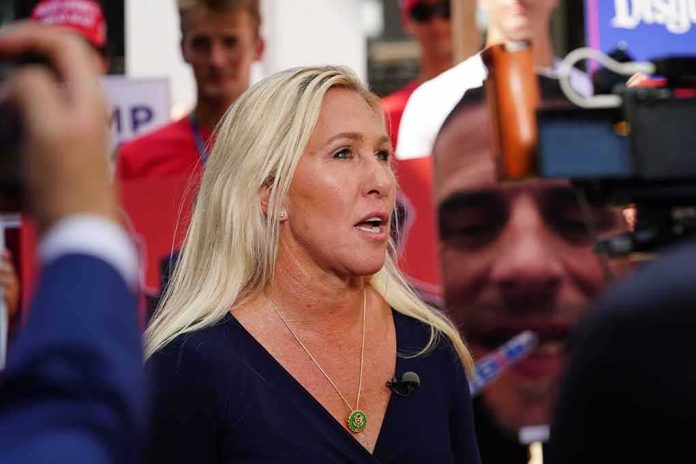
A Wisconsin congressional candidate who campaigned as a broke, hardworking waitress waited until two days after her primary to reveal she had also been paid by two groups tied to billionaire George Soros.
Quick Take
- Rebecca Cooke got a 90-day extension and filed her financial disclosure on August 13, 2026, two days after Wisconsin’s August 11 primary.
- The filing shows she earned more than $5,000 each from Third Way and The Pipeline Fund, two groups with financial ties to George Soros’ Open Society network.
- The same disclosure lists $60,000 in political consulting income and a rental property, on top of her waitressing job.
- Cooke has spent years telling voters she is “working class” and “not wealthy,” while past filings showed six-figure consulting earnings.
- Delayed personal financial disclosures are a known problem, with a watchdog group flagging dozens of candidates in 2024 alone.
Delayed Disclosure Surfaces After Primary
Rebecca Cooke, the Democrat running to unseat Republican Representative Derrick Van Orden in Wisconsin’s 3rd Congressional District, asked for a 90-day extension on her required House financial disclosure. That pushed her filing deadline to August 13, 2026, two days after the state’s August 11 Democratic primary. Local reporters had flagged in July that voters might not see her income sources until after they had already cast ballots.
The disclosure itself, signed by Cooke and covering January 2025 through mid-July 2026, lists compensation over $5,000 from Third Way and The Pipeline Fund. Both organizations have documented financial ties to George Soros’ Open Society network. News outlets reported the payments came to light only after primary voters had already picked their nominee, raising questions about what they knew when they voted.
Payments From Soros-Linked Groups Revealed
Third Way is a Washington, D.C. think tank, and The Pipeline Fund works to elect progressive candidates. Cooke’s disclosure describes her duties for Third Way as a “fellowship.” Neither payment was publicly known before the primary. The timing has drawn criticism because campaign finance law exists specifically to let voters know who is paying a candidate before they decide how to vote.
Waitress Image Meets Consulting Income
Cooke has built her political brand around working a waitressing job while running for Congress. She has told interviewers she grew up on a dairy farm her family eventually had to sell off due to falling milk prices. “I wish they could see the car I drive and the home I live in,” she said in 2025. “Anyone who knows me understands that I’m certainly not wealthy”.
Her own paperwork tells a more complicated story. The new disclosure documents $60,000 in consulting income alongside a local rental property. Earlier filings from her 2024 run showed she earned over $190,000 from her consulting firm, Cooke Strategy, between 2015 and 2021, along with two waterfront properties. Van Orden’s campaign says her political work now brings in six times more than her waitressing job.
Opponent and Watchdogs React
Van Orden’s campaign seized on the disclosure, arguing it undercuts the working-class image Cooke has sold to voters for two election cycles. Cooke’s team has pushed back, saying the filing proves she is being transparent and that voters can look at her full financial history across multiple years to judge her for themselves. Her campaign has raised more than $8.6 million in the race, according to Federal Election Commission records.
🚨 YOU CAN’T MAKE THIS UP.
Rebecca Cooke built a working-class campaign image around waitressing and struggling to afford health insurance.
Then she obtained a lawful 90-day extension that pushed her financial disclosure until two days after Wisconsin’s Democratic primary.
The…
— JonathanFrye (@jonathan_f32966) August 30, 2026
Late Filings Are a Familiar Pattern
Cooke is far from alone in delaying required financial paperwork until after voters have gone to the polls. The nonpartisan Campaign Legal Center found more than 47 Senate candidates in the 2024 cycle missed or delayed their legally required personal financial disclosures, with at least nine still running while making unverified claims about their own campaign loans. That pattern feeds a broader frustration shared by voters across the political spectrum: rules meant to keep candidates accountable often bend for the people they are supposed to check, regardless of party.
Sources:
thegatewaypundit.com, yahoo.com, disclosures-clerk.house.gov, wqow.com, fec.gov, prospect.org, townhall.com, wisconsinindependent.com