

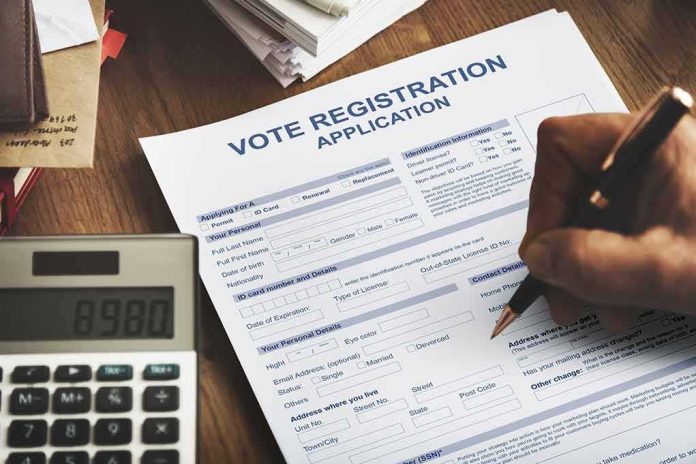
California’s own rules let residents register to vote without a driver’s license or Social Security number, then cast ballots without showing ID in most cases — and that design choice explains the entire voter ID fight now on the ballot.
At a Glance
- California allows registration without a license or Social Security number, assigning a unique voter identifier instead.
- Most voters are not asked for identification at polling places under current guidance.
- First-time by-mail registrants who skipped key numbers can be asked for ID, including certain non-photo documents.
- State rules rely on database checks and later processing more than front-end documentary proof.
What California Actually Requires To Register And Vote
California’s registration form asks for a driver’s license, a state ID, or the last four digits of a Social Security number. The state also says you can register without any of these. The county then assigns a unique voter identifier. That number anchors your record going forward and allows processing to continue without a traditional ID on file. The Secretary of State also explains that county staff add your signed affidavit to the record as part of the file.
At the polls, most Californians are not asked to show identification before voting. That is the default under state guidance. The exception hits a narrow slice: first-time voters who registered by mail and did not give a driver’s license, state ID, or Social Security digits. In that case, a poll worker may ask for proof of identity. The list can include a recent utility bill, a sample ballot booklet, a government document, or a standard photo ID like a passport or driver license.
How Verification Works Behind The Scenes
The system leans on matching and paperwork rather than a universal show-your-ID rule. State regulations direct officials to match driver’s license numbers with Department of Motor Vehicles records and Social Security digits with federal data. When a registrant has neither number, the state assigns a unique identifier to that voter’s record for tracking and future use. The logic is administrative: confirm what you can through databases and signatures, then use targeted ID checks only where federal law requires it.
This blend explains why critics and defenders talk past each other. Critics see missing numbers at sign-up, no ID at the polls for most voters, and conclude the front door is wide open. Defenders point to signature files, Department of Motor Vehicles and Social Security checks, and the first-time voter backstop, and argue the system works as intended. Both sets of facts can be true at once because the structure puts trust in back-office checks rather than on-the-spot ID.
The Claim About “Any Card” At The Polls
Some allege that a voter could wave almost any card at the polls. The official list does not support that claim. The acceptable documents for that narrow first-time category are spelled out and do not include random club cards or insurance cards. The guidance lists a recent utility bill, the sample ballot booklet, another government document, or a standard photo ID like a passport, driver license, state ID, or student ID. Policy arguments aside, stretching that list undermines a serious case.
Used to be that way.
Here in California, they passed a motor voter law that requires everyone that geys anything done at the DMV (Drivers License, title, registration,etc), MUST register to vote.
There's even a box to check to say you don't have a Social Security number, or…
— MAGAman (@hydrogentechguy) September 2, 2026
From a common-sense, conservative view, the core issue is where to place the burden. A statewide rule that says “show government-issued ID every time” is clear, even if opponents say it may burden a few edge cases. California’s choice trades that clarity for a process-heavy approach that assumes database hygiene, matching accuracy, and clean roll maintenance. If you value trust through direct proof, the current setup will not feel sufficient, even if documented fraud counts remain low.
What To Watch As The Ballot Fight Heats Up
Expect both sides to quote the same rules and draw opposite lessons. Supporters of stricter ID will highlight that you can leave key fields blank, still register, and in most cases vote without ever showing identification at a polling place. Opponents will cite the matching steps, the unique identifier system, and the targeted first-time checks to argue the framework already verifies identity where needed. The ballot question boils down to whether voters want a uniform ID step at the front end or trust the back end to catch problems.
Practical Questions That Deserve Straight Answers
Three numbers would cut through the noise. First, how many active registrants lack both a driver’s license or state ID and a Social Security number and therefore rely only on a state-issued identifier? Second, how many first-time voters trigger an ID request at the polls, what share bring acceptable documents, and how many ballots go provisional or are rejected? Third, how often do Department of Motor Vehicles and Social Security matches fail and how are those cases resolved? Publish those, and voters can judge the tradeoffs.
Sources:
thegatewaypundit.com, sos.ca.gov, elections.cdn.sos.ca.gov, voteriders.org, ballotpedia.org