

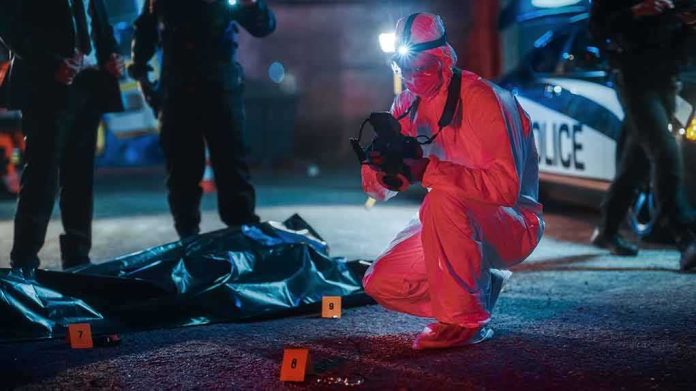
A neighbor says an 18-year-old dropped a plastic tub with a human torso, then ran.
Story Snapshot
- Police say a torso in a tub led them to arrest Kingston Bradley, 18.
- Investigators later upgraded charges to malice murder after finding more remains.
- A witness identified as the victim’s aunt says she saw Bradley flee.
- Bradley is jailed without bond and has not given police a statement.
Witness account, torso in a tub, and a swift arrest
Cobb County officers answered a missing person call at a Smyrna complex. A witness told police she saw a young man carrying a plastic tub that held a body. When he realized he was seen, he dropped it and ran to a nearby apartment, the warrant says. Officers found a dismembered torso in the container. Police identified the man as 18-year-old Kingston Bradley and arrested him on a charge of concealing a death soon after.
Police documents and local reports name the witness as Michelle Weaver, the victim’s aunt, who confronted Bradley earlier at his door. She later reported seeing him with what looked like a bag around a container before he threw it and ran. This level of detail in a warrant matters. It fixes time, place, and conduct in plain language a jury can weigh. It also links a named witness to a specific act: possession of human remains in public view.
From concealment to murder: what the upgrade signals
Police first booked Bradley on concealing a death, a charge that often comes before homicide in dismemberment cases. That sequence fits common forensic practice. Investigators moved to a malice murder charge after executing a search, then locating more remains believed to be the victim’s in a vehicle trunk, according to police briefings. The murder upgrade signals prosecutors now see a tighter link between the suspect and the killing, not just the handling of remains.
Reporters note that Bradley remains in the Cobb County jail with no bond. Police said he has not provided a statement to detectives. Officials also said they have not publicly tied him to a specific dismemberment tool yet, which often takes laboratory and autopsy work to confirm. Those gaps do not erase the core evidence of possession and flight, but they mark what still needs to be proven in court. The presumption of innocence still applies.
The victim, the family’s search, and the timeline tension
Family members searched the complex and found the tote with the torso, which they believed was their missing relative. They pressed for answers at Bradley’s door and later reported seeing him move with a bag and container before he ditched it and ran. Police say the initial call came in as a missing person, then turned into a homicide scene once the remains surfaced. That turn explains why concealment charges came first. The homicide case builds on lab work and autopsy timing.
They found a Georgia DoorDash driver's torso in a tub – now her 18-year-old neighbor is under arrest. He's also reportedly FURIOUS that his mugshot has been released, so naturally we're circulating it EVERYWHERE!!
⠀
The suspect is held without bond at the Cobb County jail. A… pic.twitter.com/edD23sR2Fc— Blue Lives Matter (@bluelivesmtr) September 26, 2026
DoorDash activity did not place the victim on an active delivery at that complex during the period in question, a detail reported as the family’s early theory shifted to hard evidence from the scene. That kind of correction matters. Trials often hinge on what can be proved, not what seems likely. The state’s case will live or die on physical links, timelines, and whether jurors believe the witness who says she saw the tub with a body and the suspect’s flight.
Why dismemberment cases start with what can be seen
Conservative common sense says start with what you can prove. You can see a tub, a torso, and a suspect running. You can document a bleach smell, a container, and remains found after a lawful search. You cannot guess at motive or tools until tests come back. That is why concealment often leads the charge sheet while labs do their work. Prosecutors then add murder if the pathologist and investigators close the loop with cause, manner, and linkage.
Sources:
nypost.com, ajc.com, newsbreak.com, fox5atlanta.com, fox7austin.com, 13newsnow.com