

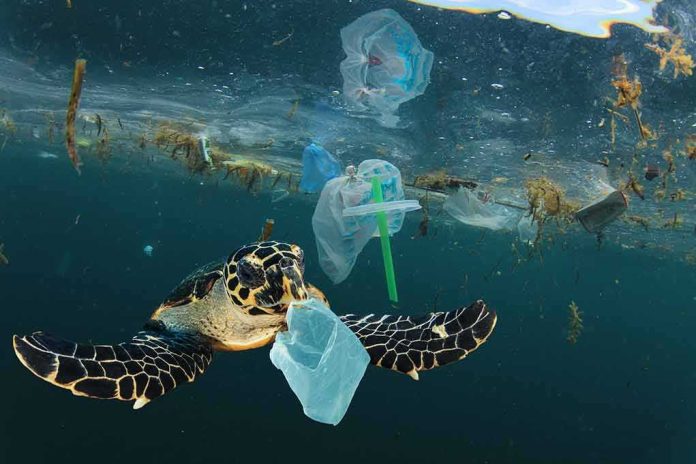
When Southern California’s coastal waters run several degrees warmer than normal for months on end, the ocean changes character: tropical and subtropical species ride north on the heat, behaviors shift, and—on rare occasions—the biology of entire coastlines rewrites its own boundaries.
The Short Version
- Warm phases of the Pacific—El Niño layered atop marine heatwaves—can temporarily “tropicalize” California waters, ferrying species like hammerheads, whale sharks, and even sea snakes northward.
- In 2026, two olive ridley sea turtles laid eggs on Orange County beaches—the first recorded natural nesting by any sea turtle on the U.S. West Coast, consistent with unusually warm conditions.
- These events fit a well-documented ecological pattern: prolonged warming reorganizes the California Current’s food webs and ranges, not just anecdotal sightings but community-level change.
- Attribution has nuance: El Niño and heatwaves load the dice for tropical visitors; no single arrival is “caused” by one driver alone.
Why warm water moves warm-water life north
The California Current flows south along the West Coast, normally importing cool, nutrient-rich water that favors kelp forests, rockfish, and temperate seabirds. El Niño inverts that logic at the surface. When the equatorial Pacific warms and trade winds slacken, downwelling Kelvin waves propagate east, deepen the thermocline, and suppress the upwelling that keeps our nearshore waters cold. The result near California: a broad, shallow veneer of anomalously warm water, often several degrees above average, that rides poleward along the coast. Tropical and subtropical organisms—pelagic fish, rays, sharks, sea turtles—move with those isotherms. Some simply follow prey; others track preferred temperatures for metabolism, foraging efficiency, or reproduction. If a preceding marine heatwave has already primed the system, El Niño’s push is stronger and lasts longer, increasing both the number and the diversity of warm-water vagrants that make it north of Point Conception.
None of this is speculative. During strong warm phases, aerial spotters and anglers log dorado and tuna within day-trip range of Newport or Dana Point; divers film fin devil rays and hammerheads; whale sharks cruise the Southern California Bight; and, in exceptional years, yellow-bellied sea snakes—a true tropical—wash ashore after warm-water incursions. These are signatures of a physical driver reorganizing habitats in real time, not isolated curiosities.
The nesting that reset a biological map
The clearest line on a range map is where a species breeds. Sightings come and go with currents; nesting means the environment crossed a threshold of suitability. In September 2026, two olive ridley sea turtles—a species whose core nesting beaches sit hundreds of miles to the south—came ashore in Orange County and laid eggs: first near Seal Beach, then three days later near Huntington Beach. NOAA Fisheries and the U.S. Fish and Wildlife Service called it what it is: the first-ever recorded natural nesting by any sea turtle species on the U.S. West Coast. Local lifeguards and biologists fenced the sites to prevent disturbance; with heavy surf forecast, more than 200 eggs were later excavated and safeguarded at the Aquarium of the Pacific to maximize hatch success under unstable beach conditions.
Why did it happen then? Agencies and field biologists pointed to exceptionally warm sea-surface temperatures from ongoing marine heatwaves compounded by an emerging strong El Niño, which together extended tropical-like conditions into Southern California’s nearshore zone during the late-summer nesting window. That framing is consistent with the physics—warmer surface waters, deeper thermocline, altered prey fields—and with concurrent tropical visitors seen throughout the Bight. It also aligns with prior warm events when hammerheads, dorado, and even manta relatives surged northward in step with temperature anomalies.
From anecdotes to ecosystem: what long records show
Anecdotes draw attention; time-series reveal pattern. The California Current has a deep observational archive—from larval fish collections to eDNA and trawl surveys—that captures community-level responses to extreme warming. Analyses of the 2014–2016 Northeast Pacific marine heatwave (itself prolonged by a strong El Niño) documented a marked northward expansion of southern, warm-affiliated fishes, concurrent declines in some temperate taxa, and shifts of offshore warm-water species into shallower habitats. One 23-year record combining ichthyoplankton microscopy with environmental DNA showed that the assemblage’s center of mass moved toward southern, mesopelagic species during warm anomalies—an ecological fingerprint that matches the sightings narrative but is grounded in repeated, standardized sampling.
These studies matter because they separate signal from spectacle. A single blue marlin near Newport is unforgettable; a multi-year reshuffling of larval communities, forage availability, and predator distributions is consequential for fisheries, protected species management, and coastal economies. When the surface ocean stays hot for months, squid fisheries shift latitude, billfish flirt with Catalina waters, and sea lion and seabird rookeries ride the knock-on effects—boom for some, bust for others.
Attribution with discipline: El Niño, heatwaves, and climate background
It is correct—and responsible—to say warm phases load the dice for tropical visitors; it is not precise to pin any single arrival on El Niño alone. Marine conditions arise from overlapping drivers: basin-scale climate modes like El Niño–Southern Oscillation, persistent marine heatwaves, local upwelling winds, and longer-term anthropogenic warming that raises the baseline and can amplify impacts. Statistical and process studies link nearshore marine heatwaves in the California Current to ENSO phases and upwelling variability, clarifying when and where warm extremes cluster. In practice, managers and scientists approach attribution as a mosaic: El Niño provides the pathway, marine heatwaves provide persistence, and the background warming trend makes threshold crossings—like successful nesting—more likely during each warm episode.
That is why agencies described the 2026 turtle nests as unprecedented and linked them to the unusual warmth without oversimplifying causation. The physical context was there; the biological response crossed a historic line.
Implications for coasts, fisheries, and conservation
For coastal communities, warm-water incursions are a mixed ledger. Charter captains and anglers relish dorado, tuna, and the occasional billfish within easy range; tourism spikes on charismatic sightings. At the same time, kelp forests—foundational habitat for abalone, urchins, and nearshore fish—suffer under prolonged warmth and reduced nutrient supply, particularly when compounded by grazing pressure from urchin booms after urchin predators collapse in heat-stressed systems. Sea level rise and energetic winter storms arriving over a warmed, expanded ocean intensify erosion and flooding risks along already sand-starved beaches. Managing this portfolio demands local vigilance—dune restoration, living shorelines, adaptive fisheries—and a firm grasp of seasonal to interannual outlooks when El Niño takes hold.
For conservation, the lesson is flexibility. When a threatened turtle nests 700 miles north of its usual range, rescue and monitoring protocols must be ready outside traditional hotspots; lifeguards become first responders for protected species, and aquaria serve as emergency nurseries when swells threaten newly laid clutches. Over the longer term, agencies will track whether the 2026 nests were a one-off born of anomalous warmth or the leading edge of a recurring behavior during future warm phases. Either way, the capacity to detect, protect, and learn from such events is now part of West Coast stewardship.
How to read the next warm year
Think in layers. Start with the seasonal forecast: if ENSO indices point to a strengthening El Niño, expect a warmer, deeper surface layer and muted upwelling along Southern California heading into late summer and fall. Check for marine heatwave alerts; if anomalies stack for weeks over the Bight, the odds of tropical visitors rise. Then watch the biology: bait schools, squid landings, unusual ray and shark reports, and sea turtle sightings. The pattern hangs together. The physics move the isotherms; life follows; managers and communities adapt in real time.
Sources:
youtube.com, fisheries.noaa.gov, ocregister.com, opb.org, latimes.com, upi.com, smithsonianmag.com