

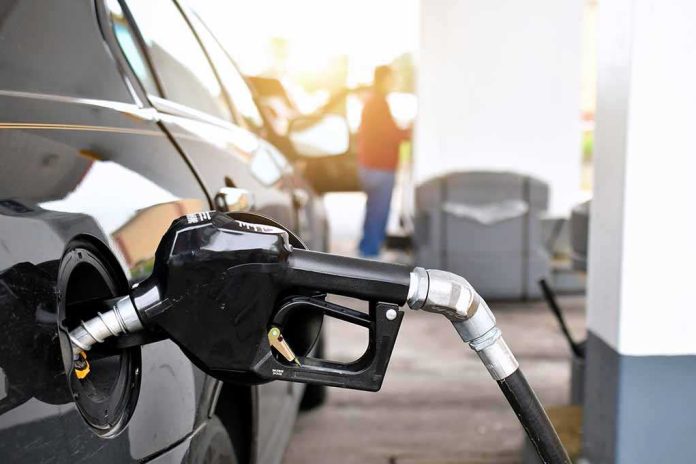
Farmers facing the worst diesel prices in years just got an $8 billion lifeline from Washington.
Quick Take
- The United States Department of Agriculture (USDA) announced an $8 billion Harvest Fuel Relief Program on October 19, 2026, to help farmers through this year’s harvest.
- The Farm Service Agency will run the program using money from the Commodity Credit Corporation.
- Payments will use a uniform formula based on modeled losses, not a direct per-gallon diesel refund.
- A separate executive order from earlier in October lets truckers and farmers use tax-free dyed diesel on highways through the end of 2026.
What USDA Announced And Who Will Run It
The USDA says it will make $8 billion available for one-time payments to American farmers this harvest season. The Farm Service Agency will administer the money under the Commodity Credit Corporation Charter Act, a law that lets USDA respond quickly to farm economy problems without waiting on new legislation. President Trump and Agriculture Secretary Brooke Rollins both announced the plan.
Reuters reported the same day that Trump said the program would give farmers $8 billion to help offset diesel costs during harvest. That framing matches what farmers have been feeling in their wallets. Diesel powers nearly every machine on a farm, from combines to grain trucks, and when fuel prices spike, harvest costs spike right along with them.
How The Money Will Actually Be Paid Out
USDA describes the payments as simple and proportional, using one uniform formula to cover part of each farmer’s modeled losses for the 2026 crop year. That is different from a straight diesel-gallon reimbursement. The program is built around estimated losses tied to input costs, not fuel receipts turned in at a county office. Farmers will not need to prove exactly how much diesel they burned to qualify.
One detail is still missing: the exact payment rate. Reporting at the time of the announcement noted that USDA would not release those rates until November, so individual farmers could not yet calculate what they would personally receive. That is a normal part of standing up a new relief program, not a sign of trouble, since formulas and acreage data take time to finalize before checks go out.
A Second, Smaller Measure Targets The Diesel Tax Itself
Two weeks before the $8 billion announcement, Trump signed a separate executive order addressing diesel taxes directly. The order temporarily allows highway use of tax-free dyed diesel, which is normally restricted to off-road farm equipment, and defers the federal diesel excise tax through the end of 2026. The White House pitched it as a way to cut fuel costs for truckers and farmers at the pump, with savings up to 100 dollars per fill-up.
Why The Two Numbers Should Not Be Confused
Secretary Rollins estimated the dyed-diesel order would produce roughly 640 million dollars in combined federal and state savings across about 224.6 million harvested acres. That figure is far smaller than the $8 billion harvest relief program, and the two documents do not say the 640 million dollars is part of the 8 billion dollars. They are separate tools: one adjusts tax rules, the other sends direct payments based on modeled losses.
Trade outlet DTN reported the tax order defers payments rather than canceling them outright, meaning the 24.4-cent-per-gallon federal diesel tax is not eliminated and deferred amounts could still come due later. Treasury and the Internal Revenue Service (IRS) were also directed to determine how existing law applies and how penalties will be handled, which means some details depend on agency follow-through.
How This Fits Agriculture’s Long History Of Emergency Aid
Washington has leaned on ad hoc farm payments for decades whenever natural disasters or market shocks hit rural income hard. Congress authorized billions in disaster assistance from 2017 through 2022, and the first Trump administration spent roughly 30 billion dollars keeping farmers afloat during the trade war and pandemic years. This latest program fits that same playbook of using USDA and the Commodity Credit Corporation to move money fast when farmers need it.
Trump Announces $8 Billion Farmer Diesel Relief at Kansas Rallyhttps://t.co/qYFIw0uSsA pic.twitter.com/zRhXjR8vdg
— Next News Network (@nextnews) October 20, 2026
Farm groups have welcomed the announcement, and it is easy to see why. Diesel prices eat directly into a farmer’s bottom line during the narrow window of harvest, when machines run nonstop and there is no waiting for better prices. Getting real dollars into farmers’ hands before winter bills arrive matters more than parsing which federal account the money came from.
Sources:
cbsnews.com, whitehouse.gov, usda.gov, usnews.com, kansascity.com