

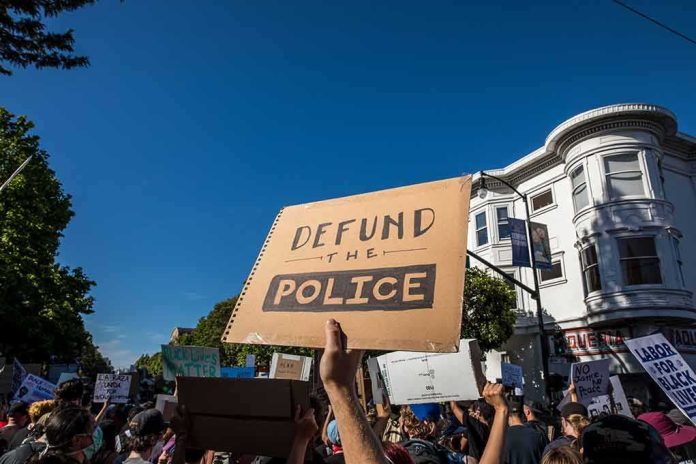
Madison now has an encampment ringed with boards studded with nails, blocking a city street that officials themselves are helping keep closed.
Story Snapshot
- Protesters have seized two blocks in Madison after the police shooting of Corey Ruiz and fortified them with nail-studded barricades.
- The city closed the intersection to vehicles and brought in salt trucks, trash service, and portable toilets that keep the encampment running.
- Residents and business owners inside the zone say they feel trapped, cut off, and frustrated by the ongoing blockade.
- The clash reveals how “managing” a protest can slide into materially supporting an occupation that undermines basic public order.
A fortified protest camp grows into a de facto autonomous zone
Protesters linked to Black Lives Matter and Antifa occupied the intersection of Williamson Street and South Baldwin Street in Madison after a police officer shot and killed 38-year-old Corey Durrell Ruiz, a repeat offender who allegedly charged at officers with a knife. They did not just hold marches or rallies. They seized control of about two city blocks and built barricades that turned a busy mixed-use corridor into what activists themselves call the “Corey Ruiz Autonomous Zone,” or CRAZ.
Photos and on-the-ground reporting show the encampment surrounded by boards and tire strips with nails pointing up, plus pallets, trash cans, and a camper positioned to block vehicle access. A sign on one nail-studded barrier reads, “Protests can be inconvenient. Murder is worse,” underscoring how organizers see the camp as a moral stand that justifies severe disruption. Whatever the intention, nail-studded boards in a city street are not a minor inconvenience. They are improvised spike strips aimed at keeping outsiders out and police away.
City actions that critics say cross the line from safety to support
City officials did not move quickly to reopen the street. Instead, they closed the intersection to vehicle traffic “until further notice,” citing the “ongoing public gathering within the intersection,” which in practice means the encampment. Reporting from the Milwaukee Journal Sentinel notes that the city then “bolstered the sufficiency of the encampment,” bringing in trash collection, portable toilets, and even trash and salt spreader trucks to reinforce the protesters’ own barricades. An alderman told local television that the city used salt trucks as blockades “in place of” the seized trash cans and pallet barriers.
Mayor Satya Rhodes-Conway later admitted the situation “is not sustainable or safe” and listed public health concerns, including not enough bathrooms for the crowd. Yet the city’s solution was not to clear illegal barricades or reopen public roads. It was to provide more sanitation and use city vehicles as shields around the intersection. From a public safety point of view, city staff can claim they are trying to prevent accidents and maintain some order. From a common-sense conservative viewpoint, when government trucks, toilets, and services buttress a camp that openly blocks traffic with nails, the city has moved from neutral manager to active enabler.
Neighbors feel trapped while officials talk process
Residents and business owners inside the blocked zone describe feeling “trapped” and cut off, with access to their homes and shops restricted by barricades and protest infrastructure. Local coverage quotes merchants who say the closure hurts their ability to operate and keeps customers away. This is not a quiet memorial. It is a live encampment with tents, supply tables, and demands submitted to the city, with organizers refusing to say when it will end and tying future plans to negotiations. Meanwhile, regular citizens living and working there bear the cost every day the street stays closed.
The protesters have made some allowances. Reports say they position barricades to allow access to a nearby co-op parking lot and let trucks carrying donations reach a thrift store inside the zone. That shows organizers know they control choke points and decide who gets through. In a free society built on equal access to public space, handing gatekeeping power to a self-appointed protest camp, backed by city barricades, turns core civic norms upside down. It rewards whoever is willing to be most disruptive, not whoever follows the law and pays the taxes.
A familiar pattern of protest politics with sharper edges
This fight in Madison fits a pattern we have seen since 2020. Activists set up an encampment or “autonomous zone” in response to a controversial police incident. The city, wary of violent confrontation and bad optics, tries to “manage” the situation instead of enforcing existing laws about blocking streets and erecting hazards. Officials bring in sanitation, traffic control, and emergency access. Supporters call that protecting free expression. Critics see it as indulgence of the loudest radicals at the expense of everyone else.
Agitators in Madison Use Boards With Nails to Defend Their BLM Encampment, and the City Is Helping – Twitchy https://t.co/MqMXKIWQsb
— Not Enough Dogs (@DogsEnough) July 31, 2026
Madison’s record shows the city can shut down encampments when it decides the trade-offs are too high, as it did at the Dairy Drive homeless encampment when contracts ended and nearby impacts grew. Here, however, leaders have treated a nail-ringed protest camp on a busy street with far more patience. That difference raises a hard question: are officials afraid to apply the same standards to political activists that they apply to vulnerable homeless residents? For many conservatives, the answer seems clear. Equal justice means you do not get a special zone, fortified with nails and guarded by city trucks, just because you shout the loudest.
Sources:
twitchy.com, nypost.com, youtube.com, legalinsurrection.com, cityofmadison.com, wpr.org, madison365.com, instagram.com, pbs.org, jsonline.com, townhall.com