

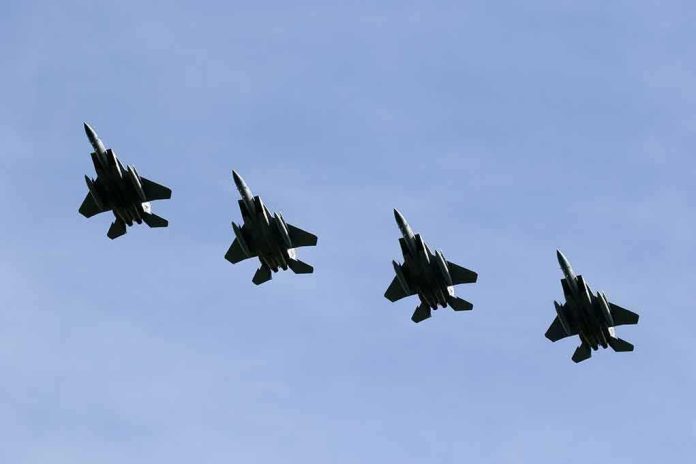
A U.S. fighter crew says a “jellyfish” drone swarm blinded their defenses over Iran—yet Washington still will not release the data that could prove it.
Story Highlights
- The downed F-15E crew reported an Iranian “jellyfish” drone formation before ejecting.
- Officials rescued the pilot and Weapon Systems Officer in a rapid special operations mission.
- Iran claims a shoulder-fired missile caused the shoot-down, not drones.
- The Pentagon has not released full debriefs or flight data, leaving key facts unresolved.
What We Know About the Shoot-Down And Rescue
U.S. officials confirmed an F-15E Strike Eagle, call sign Dude 44, went down over western Iran on April 3, 2026, marking the first U.S. fighter loss in the conflict [6]. The pilot and Weapon Systems Officer survived ejection and were recovered in a complex special operations raid about seven hours later, described by outlets as “textbook” in execution [1]. The quick recovery was a major win for the crew and for American rescue forces trained for high-risk extractions behind enemy lines [1].
Reports also state the same pilot had been shot down in a separate friendly fire incident less than five weeks earlier, confirming his deep involvement in the air campaign and the stress he faced in repeated combat [5]. That detail explains both the value of his perspective and why some analysts approach his latest account with care. Still, his testimony sits at the center of a growing debate over how Iran may be using drones to confound U.S. aircraft [5].
The “Jellyfish” Swarm Claim And Why It Matters
According to several briefed sources, the pilot described a “minefield of drones” arranged like a jellyfish, with small drones hanging under larger ones as if they were tentacles [1]. He reportedly called them “alien type drones,” signaling behavior and coordination he had not seen before [1]. A retired Air Force colonel told media that such a formation could overwhelm radar warning receivers, hinting at a shift that may require new countermeasures and faster onboard computing to cope with massed, networked targets [1].
This claim has real stakes for U.S. air dominance. If a layered swarm can mask threats, soak up attention, and open a window for a missile shot, then old playbooks fail. The United States has invested for decades in radar, jammers, and missiles designed for classic threats. Swarms are cheap, disposable, and hard to track. If this “jellyfish” model proves real, the solution demands rapid fielding of smart sensors, artificial intelligence aids, directed-energy options, and point-defense guns sized for fighters and tankers—not only for big bases.
Conflicting Narratives And Missing Proof
Iranian sources and some reports argue that a shoulder-fired missile brought down the jet, not drones, putting the swarm theory in dispute [3]. The U.S. government has not released a formal cause. Open reports say the investigation continues, and the Pentagon has not provided the full debrief transcript or flight data to confirm what the jet saw or what hit it [3]. The lack of public evidence—no released radar logs, no imagery, no recovered fragments—keeps both claims in play without closure.
There are also questions about the pilot’s condition. Media accounts say he suffered a concussion and had endured two shoot-downs, which some intelligence officials cite to caution against relying only on his visual account [1]. That does not disprove his observation, but it means the record needs objective data. Flight data recorder tracks, radar warning receiver logs, cockpit audio, and any helmet camera video would go far to settle what the crew faced in those final minutes.
What Congress And The Pentagon Should Do Now
Lawmakers should demand timely declassification of select data from the April 3 mission, redacted for security but detailed enough to answer basic questions: Were there multiple uncooperative air objects? Did the crew receive a missile warning? Did the jet’s sensors record a swarm-like pattern? Without that, Americans are left to choose between conflicting media claims and foreign propaganda, which serves no one except our adversaries [3].
Defense leaders should fast-track counters to mass drones across the force. That means integrating lighter-weight electronic attack, hard-kill guns, and high-power microwave pods onto fighters and escorts. It also means training aircrews to recognize deceptive swarms and prioritize threats under extreme clutter. Our pilots deserve tools and tactics that match the battlefield they actually face, not the one we wish we had. Delay and denial only hand our enemies a cheap edge in the sky.
Sources:
[1] Web – The “Jellyfish-Like” Drone Swarm The Downed F-15E Over Iran
[3] YouTube – How a US F-15 Jet Was Shot Down & it’s Pilot Rescued
[5] Web – A US F-15 pilot who ejected from his aircraft over Iran … – Facebook
[6] Web – F-15E pilot downed over Iran had been shot down a month prior