

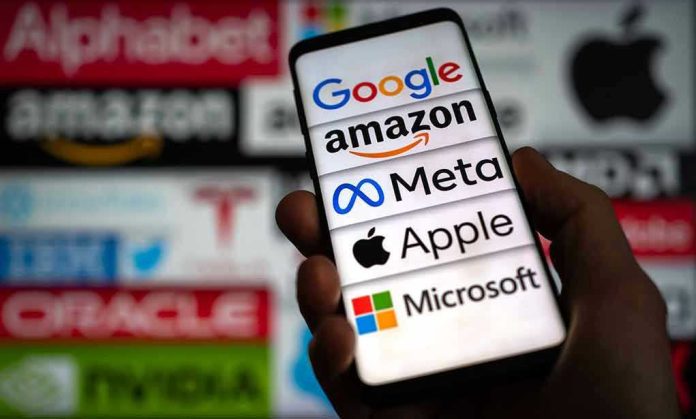
Google walked onto its biggest stage with a “missing” supermodel of artificial intelligence, and the silence around Gemini 3.5 Pro may tell you more about big tech than any demo ever could.
Story Snapshot
- Google showcased the smaller Gemini 3 Flash while holding back its hyped Gemini 3.5 Pro flagship.
- Public documentation shows Google prefers slow, gated rollouts over big-bang releases.[2][4][5]
- Developers are already complaining about slowness in existing Gemini Pro models, raising questions.
- Strategic delay, technical strain, and narrative control all collide in this “not ready yet” moment.[2][5]
Google’s Missing Headliner And The Groan Heard Around The Room
Developers packed into Google’s conference expected to see the new heavyweight, Gemini 3.5 Pro, step into the ring. Instead, chief executive Sundar Pichai told them the model “wasn’t ready yet” and asked for another month, drawing audible groans from a crowd that lives and dies by early access.[2] That reaction matters. These are not casual users; they are the people who wire Google’s models into products, businesses, and in some cases, mission‑critical systems.
Google did not leave the stage empty. The company promoted Gemini 3 Flash, a smaller, cheaper model it sells as “frontier intelligence built for speed,” and made it the new default across many products.[5] The corporate line focuses on accessibility and performance: get a fast, low‑cost model everywhere, then worry about unleashing the big guns. On paper, that sounds neat and tidy. In practice, the absence of the flagship made the whole event feel like a movie missing its final act.
Phased Rollouts: Strategy, Safety, Or Stall Tactic?
Google’s release notes show a clear pattern: nothing ships all at once.[2] Gemini versions appear as “experimental,” then “public preview,” often rate‑limited and fenced off for paying or advanced users. Gemini 3 Flash, for example, is tagged “public preview” in Google’s enterprise platform, with a precise release date and technical limits on things like media resolution.[4] This is deliberate gating. The company controls who sees which model, how often, and under what constraints before it flips any “available to everyone” switch.
That history gives the strategic‑timing argument real weight. Google’s own blog brags that Gemini 3 Flash is now the default in the Gemini app and available through search, programming tools, enterprise platforms, and more.[5] That kind of cross‑product orchestration does not happen by accident. From a conservative, business‑first lens, staggering releases is common sense: you ship something fast and cheap first to harden your pipelines, collect feedback, and de‑risk the expensive flagship. Shareholders prefer discipline over drama.
Performance Rumblings Undercut The Clean Corporate Narrative
Yet the tidy strategy story collides with an inconvenient fact: real users are already complaining that existing Gemini Pro models feel overloaded. One developer forum thread reports “a massive number of timeouts” and very slow responses when using Gemini 3 Pro over several days. That is not a polished marketing slide; it is telemetry from the field. If the current Pro tier is already gasping under load, shipping an even larger 3.5 Pro variant into the same infrastructure could turn disappointment into disaster.
Business Insider’s conference account reinforces the sense of a readiness problem, quoting Pichai onstage acknowledging that the new flagship was “not ready yet” and asking for more time.[2] That does not prove a catastrophic bug, but it does puncture the idea that this was pure, flawless choreography. A model that is fully battle‑tested rarely needs thirty extra days right at showtime. This is where common sense kicks in: when a speaker says, “You can’t have it yet,” while users elsewhere grumble about sluggish performance, something under the hood is still being tuned.[2]
Why The Truth Probably Lives In The Gray Zone
The uncomfortable reality is that both sides of the debate lean on inference because Google holds nearly all of the hard evidence. Public documentation shows carefully staged launches, preview tags, and controlled access.[2][4][5] That supports the company’s claim that it times releases intentionally. At the same time, user complaints about Gemini Pro slowness line up with the idea that capacity and latency remain real constraints, especially when millions of people start hammering a new model at once.
1. Google unveils major AI overhaul at I/O, led by Gemini 3.5 Flash.
2. Google introduces proactive AI assistant “Gemini Spark.”
3. Google Search gets AI agents, richer answers, and natural-language workflows.
4. Google re-enters smart glasses with Samsung, Warby Parker, and…— Agentic Daily (@AgenticDaily) May 20, 2026
American conservative instincts favor transparency, responsibility, and consequences over glossy narratives. On that score, Google earns mixed marks. Controlled rollouts and not shipping an unready model are responsible moves. But withholding the concrete reasons for the delay while leaning on upbeat marketing language keeps citizens, customers, and policymakers in the dark. A private company has no legal duty to overshare, but a firm that wants public trust in powerful artificial intelligence systems cannot treat clarity as a luxury line item.
What Savvy Users Should Watch Next
Anyone betting their business on this technology should focus less on the “3.5” label and more on how Google behaves between now and launch day. Do rate limits quietly tighten or loosen in the Gemini apps as 3.5 Pro approaches?[2] Does the enterprise documentation for Gemini 3 Flash and its siblings gain new safeguards, or just new marketing adjectives?[4][5] Do people still report sluggish responses once the flagship finally appears, or does performance genuinely improve across the board?
Big technology companies will always frame delays as strategic wisdom rather than scrambling to catch up. The way to cut through the spin is to track behavior over time: who gets access first, how often outages hit, and whether each new release feels like a tool you can rely on—or a demo that looks great until the next keynote. Gemini 3.5 Pro’s no‑show at the conference is not the whole story; it is the first clue in a longer investigation that users should keep running long after the stage lights fade.
Sources:
[2] Web – Gemini Apps’ release updates & improvements
[4] Web – Gemini 3 Flash | Gemini Enterprise Agent Platform
[5] Web – Gemini 3 Flash: frontier intelligence built for speed – Google Blog