

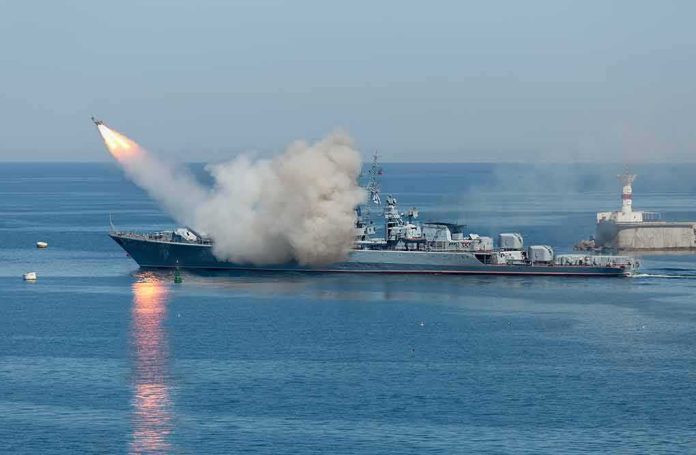
The latest U.S. strikes reaching deeper into Iran show how a limited “shipping protection” mission is quietly turning into a wider Gulf war that worries ordinary Americans on both the right and the left.
Story Snapshot
- The U.S. military says new overnight strikes inside Iran aim to stop attacks on commercial ships in the Strait of Hormuz, not to hit civilians.
- Central Command reports a growing campaign: roughly 80 targets one night, 90 the next, and about 140 in a later round, all described as Iranian military sites.
- Officials say Iran broke a fragile ceasefire with attacks on merchant vessels, and both sides now frame their strikes as “defensive” acts in a vital oil shipping lane.
- Key legal and factual questions remain hidden from the public, feeding fears that Washington and Tehran are escalating a war with huge costs and limited accountability.
U.S. Says Strikes Target Iran’s Ability To Threaten Shipping
U.S. Central Command said American forces carried out another round of strikes against Iran, aimed at “further degrad[ing] Iran’s ability to attack commercial shipping and innocent civilian mariners in the Strait of Hormuz.” The command reported about 90 Iranian military targets hit, including air defense systems, coastal surveillance assets, missile and drone storage sites, naval capabilities, and military logistics infrastructure along Iran’s coastline. Officials stressed that the operation focused on military assets, not civilian sites, and was directed by President Donald Trump.
Central Command linked these latest strikes to earlier attacks that Iran allegedly launched on commercial vessels moving through the Strait of Hormuz, one of the world’s most important oil routes. U.S. statements describe the mission as protecting “civilian mariners and commercial ships freely transiting” the strait. That framing matters for Americans who doubt Washington’s motives, because it casts the campaign as defending global trade and innocent lives rather than chasing regime change or permanent occupation.
A Sustained Campaign Reaches Deeper Into Iranian Territory
The new operation is part of a steady pattern of nightly strikes that has grown in scale and in reach. Central Command previously reported hitting about 80 Iranian military targets, including more than 60 Islamic Revolutionary Guard Corps small boats, after Iran allegedly violated a ceasefire by attacking three commercial vessels in the Strait of Hormuz. In a later round, U.S. forces struck roughly 140 targets across Iran, including missile and drone sites, ammunition storage, communications networks, and naval facilities.
Media and military reports say recent waves have extended beyond coastal areas into eastern and southern Iran, including cities such as Bandar Abbas and Chabahar, as well as other inland locations. From a U.S. perspective, this expansion is meant to reach the networks that plan and support attacks on ships, not just the launch points on the shore. For many Americans, though, “deeper strikes” sound like the country sliding into another big war, with more money spent abroad while problems at home go unsolved.
Iran Hits Back As Both Sides Claim ‘Self‑Defense’
Iran’s leadership rejects Washington’s narrative and has answered with its own strikes across the region. Iranian Revolutionary Guard officials say they targeted U.S. military facilities in Bahrain and radar systems in Oman as retaliation for American attacks linked to the Strait of Hormuz crisis. Other Iranian claims describe hitting dozens of U.S. sites in Bahrain and Kuwait after new U.S. waves of bombing. While the true damage at each location is hard to confirm quickly, the pattern is clear: tit‑for‑tat attacks are spreading beyond the shipping lane itself.
IRANIAN ATTACK IN JORDAN KILLS TWO U.S. SERVICEMEMBERS; ONE MISSING
The U-S military says two U-S servicemembers were killed and a third is missing after an Iranian missile and drone attack in Jordan.
NewsNation's Tom Dempsey is following developments.: “Overnight, the US…— Worldwide News Network (@WorldwideNNX) July 19, 2026
Both governments call their actions “defensive” and blame the other side for “unwarranted aggression,” a familiar script in U.S.–Iran crises. The United States says it is acting to hold Iranian forces “accountable for [their] attack on commercial vessels in the Strait of Hormuz.” Iran, for its part, points to earlier U.S. and Israeli strikes on its territory and argues it is responding under its claimed right of self‑defense. Ordinary citizens around the world see something simpler: each blow becomes an excuse for the next, and the cycle keeps getting harder to stop.
High‑Stakes Chokepoint Fuels Global And Domestic Anxiety
The Strait of Hormuz carries a large share of the world’s traded oil and gas, so trouble there hits everything from gasoline prices to shipping costs for goods. Recent reporting describes a “dramatic” drop in the number of ships safely passing through the corridor as the exchange of strikes continues. For many Americans already tired of high energy bills and inflation, another conflict that risks energy supply looks like proof that leaders in Washington cannot manage either foreign policy or the economy responsibly.
This concern crosses party lines. Conservative voters who distrust globalism see U.S. forces once again tied up in a far‑off fight after years of promises to put “America First.” Liberal voters who worry about the divide between rich and poor see another military campaign that seems to serve big oil and defense contractors more than working families. Both groups watch officials speak of “precision strikes” and “accountability” while basic questions go unanswered.
Missing Evidence And Legal Answers Feed ‘Deep State’ Fears
Despite detailed lists of targets, the public has not seen the classified intelligence that supposedly proves each site was a lawful military objective at the exact time it was struck. There is no released battle‑damage package showing which threats were truly removed or how many civilians may have been harmed. Independent outlets covering the fighting highlight conflicting claims about explosions and casualties, underscoring how hard it is to separate fact from spin in real time.
Legal experts also say the government has not shared a full justification for these strikes under United States law or international law. The record available to the public shows official talk about “self‑defense” and “hostile acts,” but no clear War Powers debate in Congress and no detailed Article 51 filing that ordinary Americans can read. For people who already suspect a “deep state” of unaccountable elites, this silence fits a pattern: the most serious decisions, including war, are made with secret memos and classified maps, while citizens are expected to accept simple slogans about safety and freedom.
Sources:
facebook.com, livemint.com, gulfnews.com, jpost.com, airandspaceforces.com, defence-industry.eu, en.wikipedia.org, centcom.mil, foxnews.com, cnn.com, youtube.com, tehrantimes.com, diplomacyandlaw.com, reuters.com