

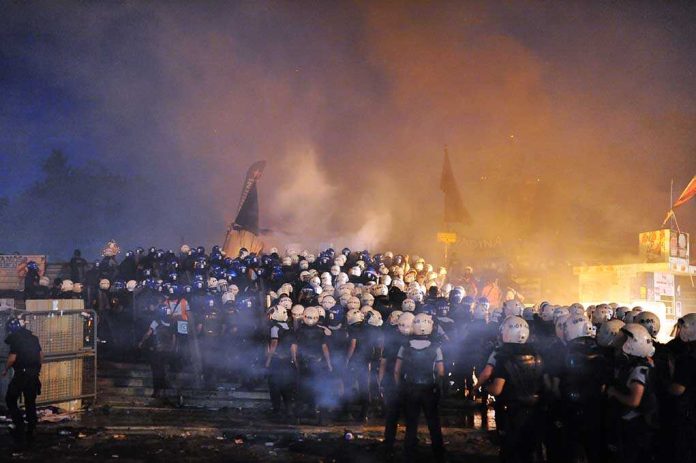
As federal agents marched 15 alleged Minneapolis Antifa militants into court, chaos erupted outside the St. Paul courthouse and forced marshals to deploy chemical spray to hold the line.
Story Snapshot
- Fifteen alleged Antifa-linked militants are charged in a sweeping federal indictment over attacks on immigration officers.[1]
- Prosecutors say the group used blockades, stalking, and threats to violently disrupt federal immigration enforcement during Operation Metro Surge.[1][2]
- Outside the St. Paul courthouse, demonstrators clashed with federal marshals, who responded with chemical spray as tensions boiled over.[9]
- Defense lawyers and left-wing activists claim political persecution, even as past cases were dropped for weak evidence.[8]
Federal Indictment Targets Alleged Antifa Organizing in Minneapolis
The Department of Justice announced an eight-count federal indictment charging 15 members and associates of a group called Direct Action Minnesota, which officials describe as a direct-action organization with Antifa ties.[1] Prosecutors say the defendants conspired to impede or injure federal officers, stalked immigration agents across state lines, made interstate threats, solicited violence, assaulted officers, and damaged government property.[1][2] A federal grand jury approved the charges, and the indictment runs 94 pages, showing a long-running plan, not a one-off protest.[7]
Federal officials tie the charges to “Operation Metro Surge,” an immigration crackdown in Minnesota that Antifa-linked groups allegedly vowed to disrupt by force.[2][3] U.S. Attorney Daniel Rosen said these individuals were not targeted for their speech, but for “what they did,” accusing them of joining a conspiracy to interfere with lawful immigration enforcement “by force.”[2] Twelve defendants were arrested in coordinated early-morning operations, one was already in custody on another case, and two remain fugitives that agents are still hunting.[2][6]
From Protest to Violence: Blockades, Stalking, and Threats
According to prosecutors, the group treated federal immigration officers as targets, not public servants.[1][2] Reports say they allegedly used “hard” and “soft” blockades, including vehicles and even blocks of ice, to slow or trap federal convoys around the Whipple Federal Building in Minneapolis.[2][3] Officials say defendants formed human chains, used homemade shields to push against agents, and damaged at least one federal vehicle by kicking and denting it during confrontations at protests earlier this year.[3]
The indictment also describes what members reportedly called “commuting tactics,” where they identified, followed, and surveilled officers away from work.[3] One defendant is accused of following a federal officer from the Whipple Building to the officer’s home in Wisconsin, behavior that supports several interstate stalking counts.[3] Prosecutors say encrypted chat messages and social media posts, including a call to “get your guns and stop these people,” back up the claim that this was organized political violence, not spontaneous protest.[3]
Courthouse Chaos in St. Paul Sparks Questions on Law and Order
As the defendants made their first appearances in federal court in St. Paul, tensions outside boiled over into a street clash.[9] Demonstrators backing the defendants packed the sidewalks and courthouse steps, chanting against immigration enforcement and accusing federal agents of abuse.[9] When marshals tried to keep entrances clear, the crowd surged, and officers responded with chemical spray to push people back and secure the doors, sending some protesters stumbling away, choking and rubbing their eyes.[9]
Inside the courthouse, prosecutors pushed to keep several defendants locked up before trial, claiming they were dangerous and could interfere with witnesses.[9] The judge disagreed, ruling that the government had not shown they were flight risks or a current threat if placed under strict conditions.[9] Most defendants were released with orders not to contact each other, not to approach federal property for protests, and to stay away from federal officers except through lawyers, underscoring that pretrial release is about risk, not guilt.[9]
Defense Cries Political Hit Job as Past Cases Collapse
Left-wing activists and defense attorneys are already painting the case as political punishment for those who resisted immigration raids.[8] Attorney Bruce Nestor pointed to earlier cases from the same immigration surge where charges against activists were dropped, claiming those charges rested on “false information” from federal agents and showed a pattern of overreach.[8] A local outlet reported that several earlier anti-immigration protest cases fell apart for lack of evidence or alleged misconduct, feeding mistrust of federal enforcement among progressive groups.[8]
WATCH: The sole broadcast network evening news report on the Minneapolis Antifa indictments was aired on @CBSEveningNews– a tiny brief.
TONY DOKOUPIL: We turn now to Minnesota, where federal prosecutors have charged 15 people but with not just protesting ICE earlier this year… pic.twitter.com/swAXFhZMS0
— Jorge Bonilla (@BonillaJL) June 17, 2026
These claims land in a country where protest law has grown harsher and more complicated over the last decade.[15][16] Civil-liberties groups have tracked dozens of new state bills that raise penalties for disruptive protests, expand “riot” definitions, and even shield drivers who hit protesters blocking roads.[15][18] At the same time, studies show a rise in politically motivated violence and a growing use of heavy criminal charges against organized protest movements, including charges like domestic terrorism or racketeering in some states.[16][22]
What This Means for Conservatives and the Rule of Law
For many conservatives, this Minneapolis case highlights a long-standing concern: that far-left networks have been allowed to hide behind the word “protest” while using force to shut down lawful government work.[1][2] When federal officers enforcing immigration law fear being stalked to their homes or rammed in traffic, it strikes at basic order and at the safety of those sworn to carry out the law. A nation cannot function if mobs can veto enforcement by intimidation or violence.[3]
At the same time, a real rule-of-law approach means getting the facts right and resisting show trials.[8][16] Past dropped cases in Minnesota remind us that some earlier charges were weak or mishandled, and conservatives should demand better, not looser, standards from federal prosecutors.[8] The right answer is not to ignore left-wing violence, but to prove it carefully in court, protect peaceful dissent for everyone, and draw a bright, firm line where protest ends and criminal conspiracy begins.[1][3][23]
Sources:
[1] Web – All Hell Breaks Loose Outside Federal Courthouse in St. Paul After …
[2] Web – 15 Members of Direct Action Minnesota, a Minneapolis …
[3] Web – 15 in Minneapolis facing charges for anti-ICE actions, feds …
[6] Web – Federal prosecutors announce charges against 15 anti-ICE …
[7] Web – Federal prosecutors charge 15 people with conspiracy to …
[8] YouTube – Federal charges against anti-ICE demonstrators spark …
[9] Web – 15 members and associates of Direct Action Minnesota …
[15] Web – DOJ charges 30 more people in Minnesota anti-ICE church protest
[16] Web – As anti-ICE protest cases falter, prosecutors notch first conviction …
[18] Web – US Protest Law Tracker – ICNL
[22] Web – The Global Suppression of Protest | American Civil Liberties Union
[23] Web – Armed Assembly: Guns, Demonstrations, and Political Violence in …