

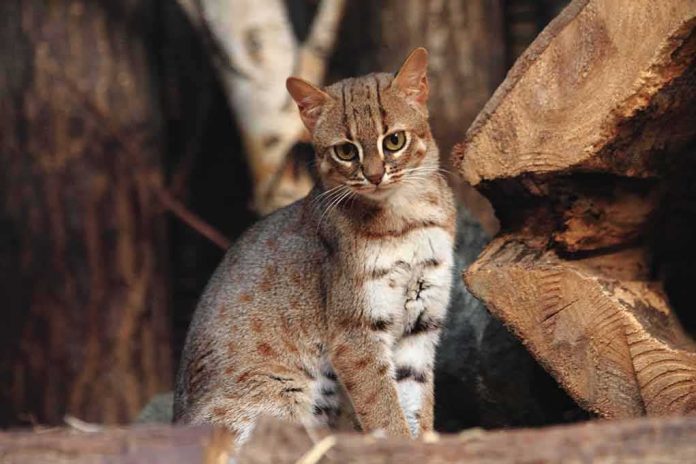
Scientists have identified a brand-new wild cat species in Bolivia, the first living feline added to science in more than a century.
Story Snapshot
- Researchers named the cat Leopardus tilcayo after confirming it is distinct through DNA analysis.
- The animal lives in Bolivia’s Yungas cloud forest and weighs only about 3 to 5 pounds.
- The species likely split from its closest relatives around 1.4 million years ago.
- Scientists documented two live individuals, including one raised at a Bolivian wildlife refuge.
A new feline joins the record books after a century
Researchers reported the discovery of Leopardus tilcayo, a small spotted wild cat that lives in Bolivia’s Yungas cloud forest. News outlets say the formal description appeared in the journal Current Biology, marking the first time in more than 100 years that a new living cat species has been named. The team used genetic comparisons to separate the animal from other tiger cats in the Leopardus group. The finding expands the known diversity of small wild cats in South America.
Scientists and local rescuers documented two known living animals during the work. One individual was captured on camera in the wild, while another arrived at a wildlife refuge as a kitten. Reporters say genetic testing showed the captive cat did not match any known species. The animal’s tiny size, spotted coat, and rounded ears also set it apart from close relatives described in the region. These lines of evidence provided a clear basis for naming a new species.
Key traits and habitat in Bolivia’s Yungas cloud forest
Field reports describe a cat weighing roughly 3 pounds and about 18 inches long, with light brown fur and irregular rosettes across its body. The rounded ears and delicate build match what biologists expect in high, wet forests where stealth and climbing help hunting. Multiple accounts place the species in the Yungas on the eastern Andean slopes near La Paz, a zone known for steep terrain, dense cloud cover, and heavy rainfall. That geography often hides species from science for decades.
Researchers and outlets say the local name “tilcayo” guided the species epithet. Scientists often follow names used by nearby communities when a distinctive animal has long been recognized on the ground. The study’s broader genetic review also clarified relationships among several South American tiger cat lineages. That context helped show that Leopardus tilcayo forms a separate branch from lookalike cats that share some patterns but differ in DNA and skull details.
What the genetics show and why it matters
The genetic analysis indicates Leopardus tilcayo diverged from the Leopardus tigrinus and Leopardus pardinoides lineage about 1.4 million years ago. That time gap is large enough to support species status in mammals with limited gene flow across mountain barriers. The work fits a modern trend in taxonomy that relies on whole-genome comparisons and museum material to sort cryptic species. This approach is common for small cats, bats, and rodents that look similar but split long ago.
Journalists report that the research compared genomes across dozens of cats collected from several countries. That broader sampling reduced the chance that the Bolivian animals were just an odd local variant. The team then cross-checked the genetics with coat pattern, body size, and skull traits. The result pointed to a stable, separate lineage. While the public reports do not include raw gene files, they present a consistent, peer-reviewed conclusion across outlets.
Conservation stakes and public interest
Bolivia’s cloud forests face logging, road building, and small-scale farming pressures. A tiny, range-limited cat is vulnerable to those changes. A formal scientific name can help trigger habitat surveys, legal protection, and funding. It also guides sanctuaries on rescue, release, and breeding decisions. Early reports do not list population numbers, which makes fieldwork urgent. Mapping where the cat lives is the next step to judge risk and plan safeguards.
Scientists in Bolivia have identified and named a previously unknown wild cat species — the first such discovery in a century. The 10-year-old wildcat, named Tigrino, is one of two known living members of the newly identified Leopardus tilcayo.
Here's more of its story. pic.twitter.com/2dZCNReWTh— CGTN America (@cgtnamerica) September 20, 2026
Many readers feel leaders focus on headlines, not hard work on the ground. This story shows how careful science, often with local partners, can deliver real wins. A rescue center’s intake, a field photo, and lab work all connected to reveal an animal we had missed. In an era when many doubt that institutions serve the public, a small, spotted cat reminds us that steady, transparent research can protect shared natural wealth for everyone.
Sources:
es.wikipedia.org, discoverwildlife.com, cbc.ca, timesofindia.indiatimes.com, livenowfox.com