

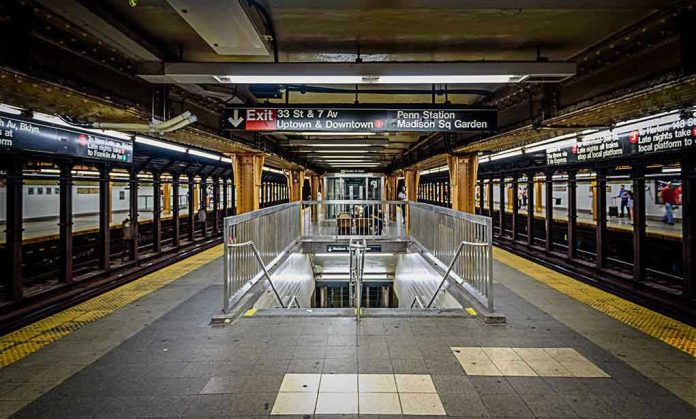
When 3,500 workers can stop a quarter-million people in their tracks before sunrise, you are looking at more than a wage dispute—you are watching a stress test of how modern America really balances work, public service, and basic fairness.
Story Snapshot
- North America’s busiest commuter railroad shut down at 12:01 a.m. after contract talks collapsed over pay and healthcare.
- About 250,000 to 330,000 riders a day were forced to scramble for backup plans, with major economic fallout. [1][3][4]
- Unions say they worked through COVID without raises and were pushed into a “management-provoked” strike. [2][3][4]
- Transit officials claim they met pay demands and that union expectations would blow up the budget. [4][5]
How A Midnight Deadline Turned Into A Rail System Blackout
Shortly after midnight on a Saturday, the Long Island Rail Road, the busiest commuter rail network in North America, went dark. Trains that normally move roughly a quarter-million riders a day between Long Island and New York City simply did not appear. [1][3][4] Five unions representing about 3,500 workers had walked off the job after talks with the Metropolitan Transportation Authority failed to produce a new contract by the 12:01 a.m. strike deadline. [3][4][6] Picket lines replaced platforms, and rush-hour planning became improvisation.
Union leaders framed the moment as last-resort, not first instinct. One official called it “a management-provoked strike,” arguing that the agency dragged its feet and then demanded concessions that had never been part of earlier talks. [2] Workers on the line pointed to the pandemic years, reminding reporters that they “brought everybody back through COVID” without time off and now faced rising prices without comparable pay. [4] Their message was blunt: we kept our end of the bargain; now management needs to keep theirs.
What The Fight Was Really About: Wages, Healthcare, And That Final Year
The core dispute came down to two pocketbook issues most readers recognize from their own lives: how fast wages keep up with inflation and who pays for healthcare. News reports say the unions sought raises roughly in the mid-teens over four years, with figures from 14.5 percent to 16 percent cited in different summaries, to reflect higher costs of living. [1][4] Management acknowledged agreeing on the first three years of the deal but balked at union demands for a richer final year, warning about “outsized” wage growth. [4][5]
Healthcare became the accelerant on this fire. A union representative said the railroad introduced new healthcare contributions for future employees “late in the 11th hour” and claimed the issue had not been on the table throughout bargaining. [2][4] Metropolitan Transportation Authority officials countered that asking new hires to pay a portion of their healthcare—about half of what an average state worker pays, according to one report—was a responsible move to contain long-term benefit costs. [2][4][5] The timing and framing of that proposal mattered; to workers, it looked like a last-minute takeaway tacked on to a paycheck still trying to catch up with inflation.
The Cost Beyond The Tracks: Commuters, The Economy, And Public Opinion
The human fallout from stopping the largest commuter railroad in North America rippled well beyond station platforms. Estimates put normal weekday ridership between 250,000 and 330,000 people, all of whom suddenly had to drive, carpool, work from home, or simply stay put. [1][3][4] The New York state comptroller pegged the strike’s price tag at roughly 61 million dollars a day in lost economic activity, a drag felt by small shops, big offices, and everyone stuck in bumper-to-bumper traffic. [1][3]
Transit managers leaned heavily on that disruption narrative. Metropolitan Transportation Authority leaders warned that giving the unions everything they wanted would require steeper fare hikes or service cuts, arguing that riders and taxpayers should not be held hostage by what they cast as excessive demands. [5] From a conservative, common-sense perspective, that argument resonates: government agencies have a duty to keep essential services running without writing blank checks. But conservatives also value honoring contracts and rewarding hard work, which complicates any reflex to simply blame workers who kept trains moving during the pandemic while government itself printed money and stoked inflation.
Fair Pay Or Fiscal Cliff? Sorting The Competing Claims
Union supporters point out that Long Island Rail Road employees went several years without a new contract or raises, even as they worked every day through COVID and watched housing, groceries, and gas spike in price. [3][4] They argue that a mid-teens raise over four years, especially after a freeze, is less a windfall than a partial catch-up, and that pushing more healthcare costs onto new hires is a quiet way to ratchet down future compensation. To many middle-aged workers who saw their own benefits chipped away over time, this playbook looks familiar.
Long Island Rail Road strike shuts down New York commuter service after contract talks collapse https://t.co/vWCGGniQ1d #LongIslandRailRoad #MTA #NewYork #LongIsland #LIRRStrike #NewYorkCity #TransitStrike #CommuterRail #KathyHochul #LaborUnions #LIRR
— Business-News-Today.com (@cricket_fundas) May 17, 2026
Agency officials counter that their offer tracked recommendations from a Presidential Emergency Board and that Long Island Rail Road workers already rank among the highest-paid railroad employees in the country. [5] They warn that going beyond that framework jeopardizes a system funded by fares and taxes. The weakness in that defense is transparency: the public has not seen the detailed side-by-side comparison of proposals, and no independent compensation audit has been aired to prove that the union’s ask would truly blow up the budget. [5]
What This Strike Reveals About Power, Risk, And Responsibility
This showdown exposes a deeper tension in modern public life: everyone wants reliable, affordable services, but few want to face what it costs to staff them with experienced, motivated workers. Transit unions sometimes overplay their hand and risk losing public support by paralyzing essential systems. Management sometimes hides behind vague warnings about “fiscal cliffs” while quietly relying on delayed contracts and eroded benefits to balance the books. Both dynamics appear in this case, and neither side has fully opened its records to scrutiny. [1][3][4][5]
For readers who remember when a train schedule felt as solid as Sunday church, the lesson is not to pick a permanent side but to demand better rules. Essential systems should rarely reach the point where a single midnight deadline can strand hundreds of thousands of people. That means faster, more transparent bargaining, clearer disclosure of real costs on both sides, and a political culture honest enough to admit that you cannot demand first-class service forever on a coach-class budget.
Sources:
[1] Web – Railroad workers walk off job, paralyzing North America’s busiest …
[2] YouTube – Long Island rail workers go on strike impacting 330,000 commuters
[3] YouTube – Long Island Railroad employees on strike over wages, healthcare
[4] YouTube – LIRR, North America’s busiest commuter rail system, shuts down
[5] Web – Thousands of railroad employees on strike in New York – CBS News
[6] Web – North America’s largest commuter rail system faces a …