

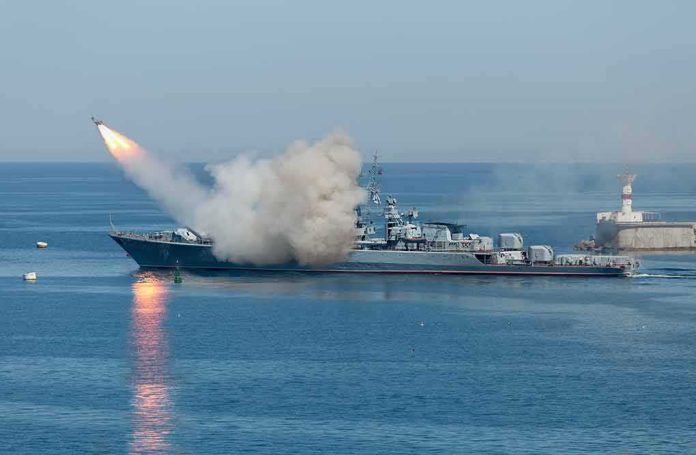
North Korea’s new 5,000‑ton “nuclear‑capable” destroyer is a fresh reminder that America cannot afford weak defense, open borders, or distracted leadership while hostile regimes arm up at sea.
Story Snapshot
- Kim Jong Un commissioned the 5,000‑ton destroyer Choe Hyon, touting it as part of a nuclear‑armed navy.
- State media claims the ship carries nuclear‑capable ballistic and cruise missiles after more than a year of testing.
- No outside experts have verified its nuclear systems, and analysts question how ready the ship really is.
- Kim is already talking about even larger 10,000‑ton warships, expanding North Korea’s reach far beyond its coast.
Kim’s New Warship: What Was Really Unveiled in Nampo
At the western port of Nampo, North Korean leader Kim Jong Un oversaw the commissioning of the 5,000‑ton destroyer Choe Hyon, the largest warship his regime has ever put into service. State media praised the ship as proof that his navy is now a “strategic” force, not just a coastal patrol fleet. The vessel was first revealed in 2025 and has gone through more than a year of trials and missile exercises, at least according to Pyongyang’s reports. For Americans, this is another clear sign that hostile regimes are investing in hard power while many in the West stay focused on “woke” priorities instead of real threats.
North Korea’s Korean Central News Agency says the Choe Hyon carries advanced anti‑air and anti‑ship weapons, plus ballistic and cruise missiles that can be armed with nuclear warheads. Kim told the ceremony that the plan to equip his navy with nuclear weapons is “following its planned course unerringly,” framing the destroyer as a flagship for this new posture. That fits a broader pattern, where Pyongyang uses every new platform to signal that its nuclear forces are more mobile, more survivable, and able to strike from sea as well as land. In simple terms, Kim wants the world to believe he can project nuclear power off his coasts and into busy sea lanes.
Missile Tests, Nuclear Claims, and Big Unknowns
North Korean reports say Kim personally supervised missile launches from the Choe Hyon, including strategic cruise missiles described as “nuclear‑capable.” He has claimed these tests mark a “radical change” in how the country defends its maritime territory, suggesting he may try to assert new sea borders that push against South Korean waters. The ship is said to have vertical launch cells for different missile types, including short‑range ballistic missiles and land‑attack cruise missiles that could, in theory, carry nuclear warheads. Yet Pyongyang has shared no technical data, and foreign inspectors have never been allowed near the vessel.
Defense analysts who have studied available footage and imagery say the destroyer’s true nuclear capability cannot be confirmed. Some experts raise basic questions, such as whether the ship’s combat systems are fully operational or if parts of the launch footage are staged for propaganda. That skepticism follows a long tradition: for years, North Korea has announced “nuclear‑capable” submarines, drones, and missiles without providing hard proof that warheads are actually integrated and reliable in combat settings. Still, the same analysts warn that even partial success would give Kim more ways to threaten U.S. allies and U.S. forces in the region, including bases and ships within reach of his growing missile inventory.
Russian Help, Bigger Warships, and What It Means for America
Photo analysis of the Choe Hyon suggests many of its systems may come from Russia, including radar and close‑in weapon mounts, which raises questions about how much of this “indigenous” destroyer is really home‑grown. If Moscow is helping Pyongyang build and arm large warships, that points to deeper military ties among anti‑Western regimes, at the very same time Washington’s foreign policy class talks more about climate rules and global governance than hard deterrence. Kim has already announced plans for even larger warships, including future 8,000‑ton and 10,000‑ton designs focused heavily on missiles instead of traditional guns.
North Korea just commissioned the 5,000-ton Choe Hyon destroyer, armed with an 88-cell VLS capable of deploying sea-based nuclear missiles. With suspected Russian tech transfers, Pyongyang is actively shifting to a blue-water nuclear navy. 🚢🇰🇵 #Geopolitics #NavalDefense #DPRK pic.twitter.com/BOSsLVG5BL
— X News (@xnewsgusrix) June 26, 2026
For American conservatives, the message is simple and serious: North Korea is pushing ahead on nuclear forces, modern destroyers, and long‑range strike systems while many Western leaders still treat border security, fiscal sanity, and energy independence as optional. Kim’s regime has already conducted six nuclear tests and more than one hundred ballistic missile tests capable of carrying nuclear warheads, with enough material for scores of bombs. A “nuclear‑armed navy” adds yet another layer to that threat. It underscores why the United States needs a strong Navy, a focused defense budget, and a foreign policy that puts American security and constitutional responsibilities ahead of globalist wish‑lists and endless distractions.
Sources:
realcleardefense.com, nbcnews.com, defencesecurityasia.com, en.wikipedia.org, beyondparallel.csis.org, facebook.com, news.usni.org, reddit.com, instagram.com, inkl.com