

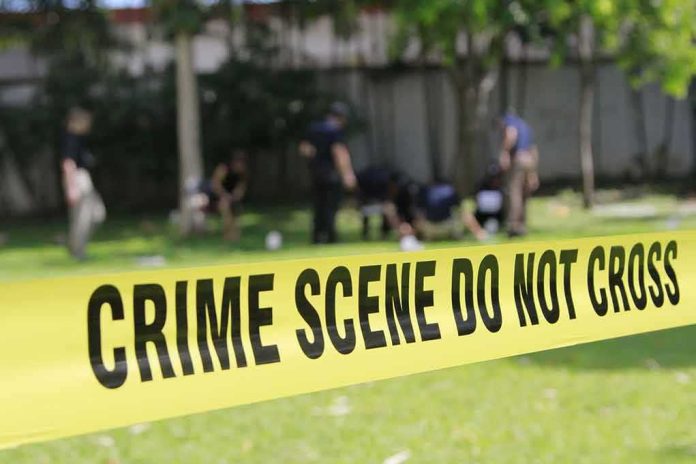
A 14-year-old was shot in the leg just off Jamaica Avenue at the edge of Rufus King Park in Queens, and the gunman — described as dressed head to toe in black — ran off. The facts are straightforward; the stakes are not. Street-corner shootings that injure teens in daylight compress public safety, policing, and neighborhood life into a single moment where response time, accurate descriptions, and community cooperation determine whether an assailant is caught and a pattern is interrupted.
At a Glance
- A 14-year-old boy was shot in the leg near 153rd Street and Jamaica Avenue, outside Rufus King Park, shortly before 5 p.m., police said.
- He was taken by EMS to Jamaica Hospital and listed in stable condition.
- The shooter, described as dressed in all black, fled on foot; no arrest has been made.
- Detectives have not announced a motive or whether the victim was targeted.
What happened near Rufus King Park
Police and EMS responded to reports of a shooting near 153rd Street and Jamaica Avenue, adjacent to Rufus King Park in Jamaica, Queens, shortly before 5 p.m. A 14-year-old boy had been struck in the leg. He was stabilized at the scene and transported to Jamaica Hospital, where he was reported in stable condition. According to the initial police account relayed through local outlets, the assailant fled on foot and was described as wearing all black. Detectives have not released an arrest, a motive, or a determination on whether the victim was specifically targeted at this stage of the investigation.
Those points — location, wound, condition, suspect description, flight, and an open investigation — constitute the reliable spine of the case as it stands. They are the pieces that drive the immediate next steps: canvassing for video, collecting ballistics if present, and reconstructing the shooter’s path in and out of the scene.
How investigators typically work a case like this
Daylight street shootings near busy intersections tend to leave traces. Investigators begin with the clock and the map: call receipt time from dispatch, first-unit arrival, and precise geocoding of where the victim fell versus where shots originated. A uniformed perimeter preserves any shell casings for ballistic analysis, which can link incidents through toolmarks when a firearm recurs across scenes. Parallel to the physical scene, detectives work the camera grid — fixed city cameras, storefront systems aimed at Jamaica Avenue, and transit-adjacent views — to tag the shooter’s clothing and gait, then follow egress blocks until an image shows a face or a distinctive item. Where the initial description is clothing-only, that video chain is what turns a silhouette into a suspect.
Witness management is the other pillar. Near-park foot traffic can produce multiple partial vantage points — a driver hearing shots, a pedestrian seeing a runner, a merchant recalling when customers ducked. Individually they are slivers; together they establish sequence. In parallel, the hospital interview, once the teen is medically cleared for questions, may clarify whether the parties knew each other, whether words were exchanged, and whether the shooter appeared to wait or passed by and fired. Each confirmation tightens the working theory — targeted versus opportunistic — which in turn guides where detectives knock next.
Why early public accounts look the way they do
In the first hours of a shooting case, the information the public sees typically flows through police to newsrooms. That is not a quirk of this incident; it is the institutional channel that supplies verified time, place, condition, and a usable suspect description while more delicate facts are still being vetted. Decades of media research document how law-enforcement sourcing dominates early crime reporting for precisely this reason: police control incident data at the start, and reporters depend on that feed for the bones of the narrative while independent documentation (footage releases, court filings) lags behind.
The tradeoff is familiar. Speed gives the community an actionable lookout and calms rumor; restraint avoids prematurely committing to motive or relationships that detectives have not finished testing. In this Queens case, the public account stays within those guardrails: leg wound, stable, all-black clothing on the shooter, flight on foot, no arrest announced, motive unconfirmed.
The geography and its implications
Jamaica Avenue at 153rd Street sits on the southern edge of Rufus King Park, a highly trafficked node that blends retail frontage with a green space used by families, seniors, and students. That mix matters for investigation and prevention. A shooting just outside park boundaries can still benefit from park-adjacent cameras and witnesses, while patrol commanders often respond with visible presence at both the corner and inside the park to deter retaliatory or copycat behavior in the following days. Location shorthand in headlines can blur the inside-versus-adjacent distinction; operationally, the difference shapes which cameras, patrol posts, and community partners are engaged first.
For residents, the situational detail is practical: disturbance patterns differ between park interiors, curb lanes, and retail doorways. If the shooter ran on foot, as reported, the most fruitful canvass corridors are the east–west spines where a runner can quickly disappear: Jamaica Avenue itself, 89th Avenue to the north, and midblock cut-throughs toward 150th to 155th Streets.
A gunman in an all-black outfit remains at large after shooting a 14-year-old boy in the leg near Rufus King Park in Queens.https://t.co/Oha1Uf1xPf pic.twitter.com/75wnJhgZgL
— Next Stamina (@NextStamina) September 7, 2026
What comes next — and what helps
Absent an arrest, the case moves on two tracks. The first is forensic: ballistics submission to link databases if casings were recovered; clothing-description correlation across recent incidents within the 103rd Precinct; and, if a caliber and rifling pattern are established, cross-checks against open cases nearby. The second is community-driven: business owners reviewing their DVR windows for the five-to-ten-minute span bracketing the shooting, bus drivers noting a runner boarding out of sequence, or residents recalling a discarded sweatshirt that matches the “all black” description. Those inputs are the difference between a generic lookout and an identifiable suspect.
For the family, “stable condition” at Jamaica Hospital is the most important sentence of the day. For the block, the most important act is cooperation — with detectives, with precinct community affairs, and with each other. In New York, cases like this are solved not by one sweeping revelation but by dozens of small, verified facts that align: a clear frame on video, a time-stamped receipt, a consistent witness line. That is how a teenager shot at the edge of a park becomes more than a headline and how an anonymous figure in black becomes a name, a charge, and a court date.
Sources:
qns.com, fox5ny.com, nydailynews.com, nypost.com, queensda.org, facebook.com, centsondollar.com