

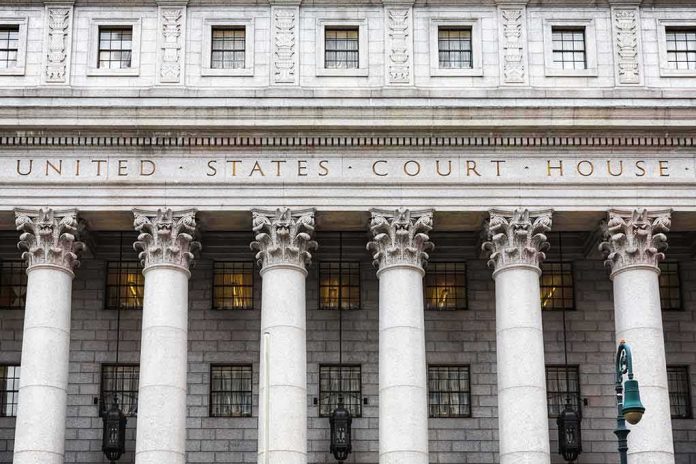
When a federal judge dies mid-docket, institutions—not headlines—determine what happens next; Alvin K. Hellerstein’s passing at 92 is a case study in how the judiciary preserves continuity even when the cases are politically incandescent.
At a Glance
- Judge Alvin K. Hellerstein died at 92; the Southern District of New York confirmed his death and began reassignment of his cases.
- He was presiding over the U.S. prosecution of Nicolás Maduro and had earlier issued notable rulings touching litigation involving President Trump.
- Court calendars do not collapse with a judge’s death; pending matters are reassigned by random draw or rule-driven processes to maintain continuity.
- Hellerstein’s three-decade tenure included stewardship of complex 9/11-related litigation and a reputation for direct, no-nonsense case management.
What happened: confirmed death and immediate judicial continuity steps
The Southern District of New York confirmed that Senior U.S. District Judge Alvin K. Hellerstein died at age 92 on October 28, 2026; reporting attributed the confirmation to court officials and noted he died surrounded by family. Multiple independent outlets carried the same core facts and added that his pending matters would be reassigned pursuant to court procedures, including the high-profile prosecution of Venezuelan leader Nicolás Maduro, which he had been overseeing at the time of his death. The court’s administrative response—random reassignment of cases to other district judges—tracks standard practice in large federal courts managing continuity of proceedings.
Hellerstein’s death closes the chapter on a nearly three-decade run on the Manhattan federal bench. Appointed in 1998, he became identified with difficult, sensitive dockets: decades of litigation over the September 11 attacks; politically charged disputes involving figures around President Trump; and most recently the Maduro prosecution. Tributes from court leadership emphasized his diligence and continued service late into life, a point underscored by the complexity of the matters still on his calendar.
How courts handle a judge’s death: mechanism, not melodrama
Federal trial courts are designed to absorb the unavailability of a single judge—whether due to death, disability, recusal, or elevation—without jeopardizing litigants’ rights or the public interest. While each district has its own assignment rules, the basic architecture is consistent: the clerk’s office, under the supervision of the court’s executive committee or chief judge, redistributes the “departing judge’s” docket pro rata and by lot among remaining judges, with carve-outs when specialized knowledge or related-case rules apply.
What happens to work already done? That turns on procedural posture. If a case is in pretrial motion practice, the successor judge takes the existing record as-is, revisits issues only if a party makes the requisite showing, and carries the schedule forward. If trial testimony has begun before the departed judge, many jurisdictions—and the federal system by practice—allow a successor judge to adopt the record, certify familiarity with it, and proceed, or in rare circumstances declare a mistrial if credibility findings or evidentiary rulings are so bound up in demeanor assessments that fairness demands a restart. In short, continuity is the default; do-overs are the exception, triggered by case-specific fairness concerns rather than headline pressure.
Why Hellerstein’s docket drew outsized attention
The death of a senior judge is not ordinarily a mass-media event. This one was, because the cases were unusual even by Southern District standards. On one axis, the Maduro prosecution implicates foreign policy, narco-terrorism allegations, and the delicate interface between executive recognition of foreign leaders and judicial process. On another, Hellerstein’s prior rulings in litigation touching President Trump—particularly his firm rejection of attempts to frame certain conduct as protected “official acts”—placed him in the slipstream of an era when courtroom outcomes are instantly refracted through partisan lenses.
High-profile cases take on a life of their own when they are covered across platforms over months and years; that intensity tends to make every procedural turn look like a plot twist rather than the workmanlike application of rules designed for predictability. The temptation is to see personnel changes as substantive shocks. The reality is steadier: successor judges inherit the law and the record along with the file.
What changes in the Maduro case—and what does not
The single concrete change is the nameplate on the case; the courthouse machine assigns a new district judge, who will enter a scheduling order after reviewing the record and conferring with counsel. That can mean short-term slippage on deadlines while chambers dig in; it does not mean charges are dropped, recognition doctrines are revisited by the judiciary, or detention determinations are automatically reopened. Reported accounts are unequivocal that the case continues and will be randomly reassigned within the district’s ordinary processes.
Two operational points matter for readers trying to forecast timelines. First, successor judges vary in appetite for revisiting their colleague’s discretionary calls; absent manifest error or material new facts, most keep the train moving. Second, where live testimony or complex evidentiary hearings were underway, parties may argue that credibility determinations require the new judge to “see it for themselves.” That argument sometimes prevails; often it does not. Contested restarts happen, but they are not compelled by the mere fact of judicial succession.
Hellerstein’s judicial style and legacy
Colleagues and counsel alike described Hellerstein as direct, efficient, and disciplined in his case management—traits that serve as ballast in fact-heavy, politically freighted matters. His stewardship of sprawling 9/11-related litigation demonstrated a tolerance for complexity matched by an insistence on progress; the docket marched through waves of wrongful-death, injury, and property claims over years, not months. In later years, when cases involving President Trump’s orbit and the Maduro prosecution came before him, that same temperament—skeptical of rhetorical flourish, anchored in record and rule—was visible in the outcomes that made news precisely because they declined to indulge expansive theories at odds with well-settled doctrine.
The longevity of his service also tells a quieter story about the federal judiciary’s senior status system. Judges may assume senior status—effectively semi-retirement—yet continue to carry substantial caseloads, a force multiplier for busy districts like Manhattan. Hellerstein’s continued presence on high-stakes matters into his nineties reflects both personal commitment and institutional demand.
#Venezuela | Judge Analisa Torres takes over the U.S. case against Nicolas Maduro and Cilia Flores following the death of Judge Alvin Hellerstein at 92. The trial is scheduled for June 2027.#NicolasMaduro #USJustice #AnalisaTorres #teleSUREnglish pic.twitter.com/Xo46Gm9Wpf
— teleSUR English (@telesurenglish) October 28, 2026
Why this matters going forward
For the public: personnel does not equal outcome. The identity of an experienced Article III judge shapes courtroom culture and pace, but the controlling law and accumulated record are sturdier than any one jurist. For litigants: expect a transitional pause, not a strategic reset. For the institution: the episode reaffirms the value of clear reassignment rules and the norm that courts treat judicial unavailability as an administrative continuity problem, not a jurisprudential crisis.
Brief note on cause and circumstances
Published accounts agree on the date, age, and official confirmation of Hellerstein’s death and report that he was with family; some reports describe the cause as natural while others simply report the death without a medical detail. The Southern District’s operational posture—announcing his passing and initiating reassignment—remains the anchor for what follows in court.
Sources:
cbsnews.com, sbsun.com, news.bloomberglaw.com, washingtonexaminer.com, nytimes.com