

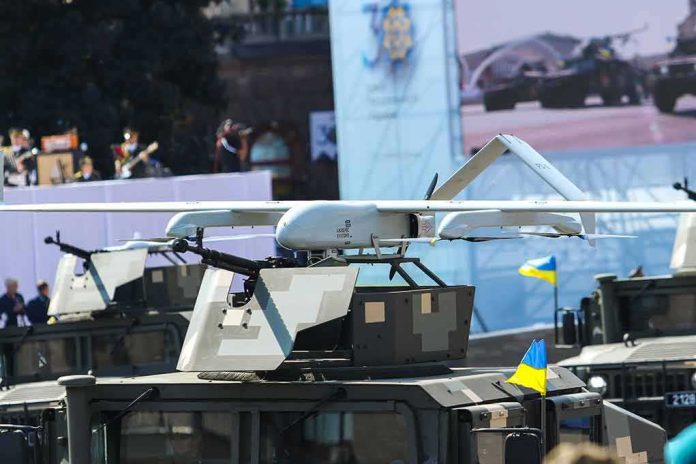
Russia’s shift to fast, jet-powered attack drones has tilted the cost and tempo of the air war over Ukraine: the salvos are larger, the flight profiles are faster and higher, and Ukraine’s established playbook for downing slow Shaheds no longer buys the same protection.
At a Glance
- Russia has deployed thousands of jet-powered “Geran” drones in recent months, with August alone seeing roughly 2,800 launches, according to Ukraine’s Air Force.
- Interception is measurably harder: Ukrainian officials say shoot-down rates for the jet variants hover near 60%, versus 90%+ for older propeller-driven models.
- The new drones fly at roughly 600 km/h and at higher altitudes, shrinking engagement windows and stressing radar, guns, and short-range interceptors.
- Ukraine is racing to field drone-on-drone interceptors and adapt layered defenses to restore cost-effective protection for cities and critical infrastructure.
What changed in the air war: speed, altitude, and mass
By mid-summer, Ukrainian officials and multiple independent outlets were describing a marked rise in jet-powered variants—identified across reporting as Geran-4 and Geran-5—appearing in large mixed salvos that also include propeller-driven drones and missiles. Ukrainian Air Force tallies cited by major outlets put August’s jet-drone launches at around 2,800, reflecting industrial-scale deployment rather than experimental use. These airframes behave differently in ways that matter tactically: they cruise roughly in the 600 km/h class, arrive from higher altitude bands, and compress the defender’s kill chain from detection to intercept to seconds and single passes rather than minutes and multiple engagement cycles.
The consequences are visible on the ground. In recent waves, some drones have penetrated layered defenses to strike urban targets in Kyiv and other cities, causing damage and casualties despite Ukraine’s otherwise sophisticated and resilient air-defense network. The profile—fast, high, relatively small radar cross-section compared to cruise missiles—erodes the effectiveness of gun-based counters and many low-cost interceptors calibrated for the older, slower Shaheds. That performance delta explains why these drones are shaping the daily rhythm of alerts, responses, and resource draws across Ukraine’s major population centers.
Interception math: why 60% is not 90%
Ukraine’s Air Force spokesperson Yurii Ihnat has drawn a clear contrast: shoot-down rates of roughly 60% for the new jet-powered drones versus more than 90% against the earlier, propeller-driven types. That gap does not mean defenses fail wholesale; it means more leakers in any given wave, more engagement opportunities consumed per night and day cycle, and a tougher budgeting problem for scarce interceptors. The physics behind the numbers are straightforward. Higher speed shortens time on sensors and under fire; higher altitude moves the engagement beyond the sweet spot of many guns and quadcopters; and the airframe’s jet signature complicates some electronic-warfare techniques tuned for piston-driven motor and propeller acoustics.
This is the textbook “cost-imposition” problem that modern air defense faces against massed, low-unit-cost attackers. If each incoming drone compels the defender to expend far more expensive missiles or surge fighter sorties, the attacker extracts value even when many drones are shot down; if the defender can force down the cost-per-intercept—through guns, EW, attritable interceptors, or tactical deconfliction—then the calculus flips back. In Ukraine today, that balance is under acute pressure from the jet variants, which have moved the fight out of several of the defender’s cheapest engagement lanes.
Mechanics of the new threat: from propeller Shaheds to turbojet Gerans
Open reporting and battlefield observation align on the core technical traits. The new Geran variants trace lineage to Iran’s Shahed family but swap piston engines for small turbojets, buying substantially more speed and climb. Multiple accounts place operating speeds in the 400–600 km/h band and routine flight at several kilometers altitude—envelopes that blur into cruise-missile territory from a defender’s standpoint, even if payload and guidance remain cruder than a Kalibr or Kh-101. The combination enables daytime attacks that earlier Shaheds struggled to survive, more flexible approach angles, and less predictable timing; it also dilutes the effectiveness of point-defense guns and ad hoc machine-gun teams that proved so potent against slow loiterers in 2022–2023.
Ukrainian and independent technical reporting has also highlighted component sourcing patterns: widespread use of foreign electronics, mesh modems, and small turbojet engines or subcomponents, with assembly concentrated in Russian facilities such as the Alabuga complex. While the exact model designations and full supply-chain forensics remain less public than the tactical outcomes, the consistent field effect—fast jet drones stressing defenses—has been corroborated across reputable outlets and Ukrainian official briefings.
Operational effects: salvos, urban vulnerability, and winter targeting
Large mixed salvos that pair jet-powered drones with traditional Shaheds, decoys, and occasional missiles are designed to pull defenders in multiple directions at once. Kyiv has endured daytime and nighttime waves, with reports of strikes on civilian infrastructure and urban logistics hubs as leakers slip through. The same dynamics apply across other cities subjected to massed drone nights: endurance for radar crews and pilots, ammunition management for Gepard-class guns, and hard choices about when to hold interceptors for higher-end threats. As winter approaches in any campaign season, the logic of targeting electrical infrastructure resurfaces; faster drones raise the risk to substations, transformers, and distribution nodes that are harder to shield at scale.
For all the pain caused, these drones are not magic weapons. They trade precision and payload for speed and cost and are still vulnerable to layered defenses that can line up radar track, cue fire-control quickly, and put the right effector in the right altitude and speed band. The problem is scale and sustainability: thousands of fast drones per month widen the cracks in even a competent defense, and they do so in a way that is fiscally asymmetric for the defender.
Russia has begun using a new modification of its jet-powered Geran-5 attack drone against Ukraine, continuing rapid upgrades intended to overcome Ukrainian air defenses and electronic warfare. pic.twitter.com/O8KuiX5WI9
— 🦋⚔️ 𓆩 𝐘 𝐀 𝐑 𝐀 𝐒 𝐇 𝐑 𝐎 𝐍 𓆪 ⚔️ 🦋 (@Yara141516) October 1, 2026
The counter-race: interceptors, fighters, and smarter layering
Ukraine is not standing still. Officials and defense-linked outlets describe active testing of dedicated interceptor drones—attritable airframes meant to meet the jet-powered Gerans in their altitude and speed regime and neutralize them without burning scarce missiles. These programs, along with better radar cueing, refined engagement doctrine, and selective use of fighter sorties, aim to restore a cheaper kill-chain against a target designed to outrun guns and quadcopters. The principle is familiar from other theaters: meet fast, small targets with fast, inexpensive interceptors; reserve high-end SAMs and fighters for cruise and ballistic missiles; and harden the grid to ride out inevitable leakers.
Expect doctrine and hardware to evolve in tandem. On doctrine: tighter integration of civilian airspace management, fast alarm-to-engagement drills, and disciplined ammunition control during mixed salvos. On hardware: more agile sensors to reduce clutter and increase track purity at altitude; improved command-and-control to hand off tracks to the right effector without delay; and counter-drone munitions purpose-built for high subsonic targets. Each adaptation pushes interception costs down and reduces the attacker’s cost advantage—exactly the strategic lever Ukraine must pull to blunt this phase of the campaign.
What to watch next
Three indicators will show whether the defense is catching up. First, the intercept rate specifically for jet-powered drones—if figures creep upward from roughly 60% toward the high-80s, the cost curve is bending back in Ukraine’s favor. Second, the composition of Russian salvos—if jet drones begin to replace missiles rather than complement them, Moscow may be economizing or probing for cheaper pressure; if both scale together, the winter grid will face tighter strain. Third, evidence of effective Ukrainian interceptor drones in routine service—once attritable, fast interceptors are flying nightly, the engagement geometry will look very different.
Sources:
military.com, abcnews.com, reuters.com, bbc.co.uk, nytimes.com, businessinsider.com, cbc.ca, militarnyi.com, unn.ua