

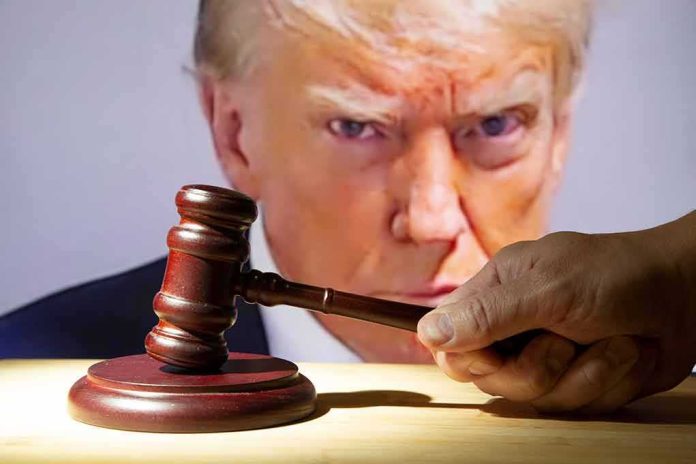
Presidential regret over Supreme Court picks is not a constitutional problem; it is a political reflex that collides, predictably, with an independent judiciary designed to ignore precisely this kind of pressure.
At a Glance
- President Trump said he regrets nominating Justices Neil Gorsuch, Brett Kavanaugh, and Amy Coney Barrett, citing rulings that went against his administration’s positions.
- The stated rationale centers on recent losses on tariffs, birthright citizenship, and election rules — emblematic disputes where policy met constitutional constraint.
- Lifetime tenure and judicial independence exist so justices can diverge from the appointing president once confirmed; this is a feature of the system, not a failure.
- History shows presidents often express disappointment when the Court rebuffs signature initiatives; the pattern says more about political incentives than about judicial fidelity.
What President Trump Said — And Why It Landed
In a Time interview published in early October 2026, President Trump answered “Yeah. Yeah,” when asked whether he regretted naming Gorsuch, Kavanaugh, and Barrett, adding that he “put them in” and that they “voted against me too often.” Multiple outlets reported the same formulation, with the criticism explicitly tied to decisions that thwarted administration aims after the justices joined the Court. The remark was not a one-off flash of pique: earlier that year he castigated two of the three over a tariff ruling, calling the decision “an embarrassment” — a throughline of grievance over adverse outcomes rather than a novel constitutional critique.
What, specifically, fueled the discontent? Reporting paired the regret with three 2026 setbacks: a ruling curbing emergency tariff authority, a decision blocking an executive order seeking to limit birthright citizenship, and a decision halting new federal mail-voting restrictions ahead of the midterms. Each case implicated separation-of-powers boundaries and long-standing constitutional understandings — the kind of disputes in which institutional guardrails predictably constrain executive ambition.
How Judicial Independence Works — And Why Appointing Presidents Get Disappointed
The Constitution’s design insulates federal judges through life tenure and protected salaries so their rulings track law and constitutional meaning, not the needs of a current administration. That independence is not decor; it is the structural answer to factional pressure. The Georgetown Journal of Law & Public Policy underscored the point in recent scholarship: the judicial power must be reposed in an independent judiciary — not a branch beholden to political patrons or transient electoral winds.
That insulation creates a well-known dynamic. Presidents choose nominees who appear ideologically aligned, but once on the bench those justices face different incentives: fidelity to doctrine, the discipline of reasoning across cases, and the reputational premium of independence. Over time, even closely aligned justices diverge on method or scope. Politicians experience those divergences as betrayal. The judiciary understands them as judging.
The Trigger Cases: Policy Ambition Meets Constitutional Limits
Tariffs and the nondelegation boundary. Recent cases forced the Court to parse the breadth of emergency trade powers. When a majority balked at stretching statutory delegations to cover expansive tariff measures, it was less about presidential identity than about Congress’s words and the limits of executive reinterpretation. Trump’s February broadside at Gorsuch and Barrett followed one such outcome; his criticism targeted the vote count, not the interpretive logic the justices applied.
Birthright citizenship. An executive effort to restrict birthright citizenship collided with a century of Fourteenth Amendment understanding and precedent. For justices anchored in text and history, the question is not presidential preference but constitutional grammar — who counts as “subject to the jurisdiction” and which branch has authority to alter that baseline absent an amendment or act of Congress.
Election rules and mail voting. On the eve of elections, federal courts generally resist disruptive rule changes — the Purcell principle — to prevent voter confusion and administrative chaos. When the administration sought to recast the Postal Service’s role and tighten mail-ballot handling, the Court declined to upend settled practice. However one rates the policy merits, the decision aligned with longstanding judicial caution around last-minute election alterations.
Regret as Rhetoric: The Politics Behind the Complaint
Expressing remorse over nominees is politically legible: it translates complex constitutional defeats into a simple loyalty narrative. Trump’s quoted line — that his appointees “voted against me too often” — maps cleanly onto that frame. But justices do not vote “for” or “against” presidents; they vote on cases and controversies, applying text, precedent, and jurisdictional rules that often run orthogonal to an administration’s immediate policy goals.
There is also a strategic logic. After high-profile losses, a president can deflect blame by implying that personnel, not policy or legal theory, was the problem — an argument that preserves the agenda’s purity while distancing the White House from defeat. Media coverage reflected this dynamic, foregrounding the “regret” line and the asserted pattern of adverse votes; the connective tissue was the run of 2026 rulings that checked executive reach.
What This Means Going Forward
First, the signal to future nominees. When a sitting president laments votes that constrict executive action, it does not change the tenure calculus — justices retain life appointments — but it does color the political environment for future selections. Presidents may tighten ideological vetting, emphasize interpretive method (textualism, originalism, deference doctrines), and demand thicker records of executive-power affinity. The result, paradoxically, can be narrower pools and higher confirmation friction.
Second, the signal to litigants and lower courts. Loud displeasure may energize allies, but it does not alter standards of review. The administrative state still must tether actions to statute; emergency powers still face judicially enforceable limits; election rules still encounter the Court’s aversion to eleventh-hour upheaval. If anything, public pressure can stiffen judicial resolve to demonstrate independence, particularly in separation-of-powers cases.
Finally, the civic lens. The episode is a civics refresher masquerading as a personnel dispute. Presidents nominate and advocate; courts adjudicate. Disappointment is inevitable in a system that refuses to collapse law into politics. That is not a bug; that is the arrangement that keeps both in their lanes.
Sources:
thedailyrecord.com, mediaite.com, westernjournal.com, worldtribune.com