

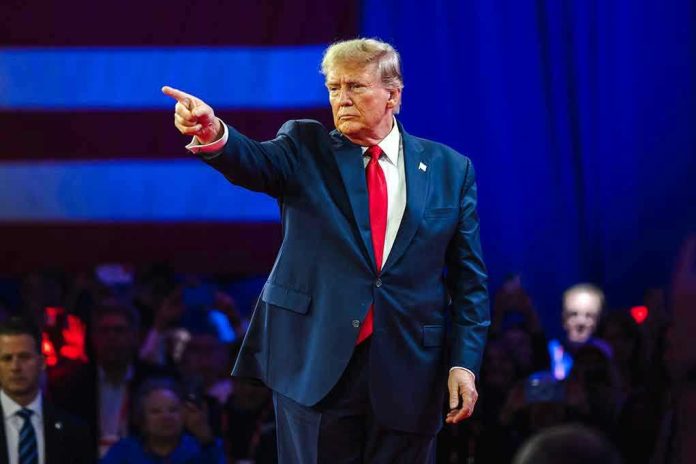
President Trump threatens to yank U.S. troops from ungrateful NATO allies Germany, Italy, and Spain, forcing Europe to face the consequences of decades of freeloading on American security guarantees.
Story Highlights
- Trump confirms initial withdrawal of 5,000 troops from Germany, signals “way down” reductions beyond that figure.
- Expands threats to pull forces from Italy (“no help”) and Spain (“absolutely horrible”) over lack of support in U.S.-Iran conflict.
- European economies contract amid energy crises, limiting their ability to step up defense spending.
- Move enforces NATO burden-sharing, prioritizing allies who reciprocate American commitments.
Trump’s Troop Withdrawal Announcement
President Donald Trump announced the withdrawal of 5,000 U.S. troops from Germany as the initial step in restructuring American military presence in Europe. He signaled further reductions, stating levels would go “way down” beyond the initial figure. This action targets Germany, which hosts the largest U.S. contingent of approximately 80,000 troops across Europe. Germany serves as a key logistical hub for Middle East operations, including the ongoing U.S.-Iran conflict. Trump links the moves to NATO allies’ failure to provide reciprocal support.
Expansion to Italy and Spain
Trump extended threats to Italy and Spain, criticizing Italy for offering “no help” and Spain for “absolutely horrible” cooperation during Iran operations. Italy maintains critical naval and air force bases for Mediterranean missions, while Spain provides strategic Atlantic positioning. These nations declined full military support, citing domestic constraints and escalation fears. Trump’s public rebukes bypass diplomatic channels, applying direct pressure on specific leaders. Italian Prime Minister Giorgia Meloni faces calls to balance nationalism with alliance preservation.
European Economic Vulnerabilities Exposed
Germany revised economic forecasts downward by 0.3 percentage points for 2026-2027, with Italy facing 0.5% growth limits and Spain sharp deceleration. Energy crises and inflation hamstring European defense budgets. Trump leverages these weaknesses, pairing military threats with tariff warnings against European autos. This exposes long-standing imbalances where U.S. taxpayers fund European security while allies underspend on defense relative to GDP commitments. The strategy demands fair burden-sharing rooted in mutual reciprocity.
NATO Burden-Sharing at a Crossroads
U.S. forces in Europe enable power projection for American interests, yet allies resist operational support. Trump’s approach echoes his first term’s push for 2% GDP defense spending, now conditioned on concrete aid like Iran conflict backing. Nationalist leaders like Italy’s Meloni and Germany’s rising AfD align closer to sovereignty-focused policies Trump favors. Critics warn of alliance destabilization, but proponents see enforced fairness preventing freeloading. European responses include damage control amid political pressures.
TRUMP'S MASTERSTROKE! Europe in CHAOS as Italy PLEADS and Germany IMPLODES!!!https://t.co/7Gm4j75IUq
— American Eagle Digital Brigade (@BrigadeSalty) May 6, 2026
Strategic Implications for America First
Withdrawals reduce U.S. overseas commitments, saving taxpayer dollars and redirecting resources homeward. They pressure Europe toward self-reliance, potentially boosting their defense industries while exposing NATO gaps adversaries like Russia or China might exploit short-term. Long-term, realignment favors reciprocal partnerships over one-sided guarantees. Military families face relocations, but base-hosting communities adapt as Europe confronts fiscal realities. This masterstroke prioritizes American interests over endless global subsidies.
Sources:
DevDiscourse: Europe in Turmoil: Trump’s Transatlantic Tactics