

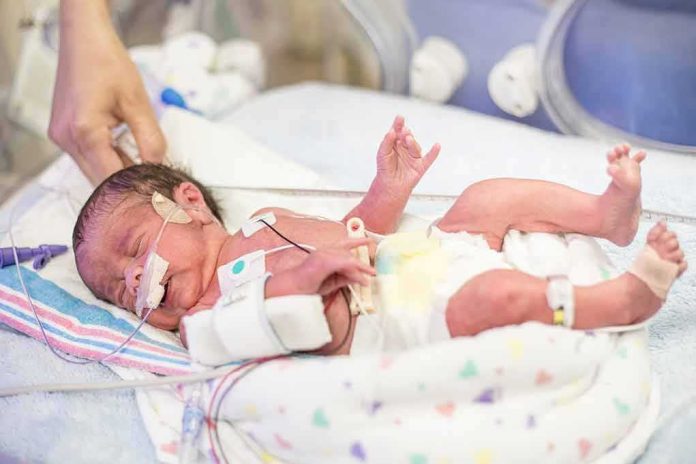
What makes the Baby Gabriel dispute legally consequential is not the rhetoric around it, but the question of who controls medical decisions when a surrogate pregnancy, a serious fetal diagnosis, and competing out-of-state parents collide inside Texas courts.
Intro Header
- Ken Paxton’s office intervened in a Dallas County parentage case and asked a court to direct the child’s care, block removal from Texas, and expedite any refusal-of-treatment hearing.
- The child, identified in reporting as “Baby Gabriel,” was diagnosed in utero with hypoplastic left heart syndrome, a severe congenital heart defect that the state describes as treatable.
- According to the reported filings, the surrogate declined an abortion request, came to Texas for protection and treatment access, and the intended parents allegedly opposed life-saving care after birth.
- The case fits a familiar Texas pattern: the attorney general’s office has repeatedly moved into high-stakes medical disputes where fetal or neonatal life is tied to court orders and parental authority.
What Paxton Asked the Court to Do
Paxton’s intervention was not symbolic. His office said it filed in the Dallas County case and sought orders that would direct the child’s medical care after birth, prohibit removal from Texas, and set an expedited hearing if the parents refused treatment consent. That is the practical center of the dispute: whether the law will let Texas doctors treat a newborn immediately and whether the child can be kept in the state long enough for that care to happen.
The reporting around the filing says the state’s theory is straightforward. Baby Gabriel was diagnosed with hypoplastic left heart syndrome, or HLHS, a serious congenital defect in which the left side of the heart is too underdeveloped to pump blood effectively. Texas outlets also reported that the attorney general’s office described the condition as treatable and told the hospitals involved that emergency, life-sustaining care could be provided without parental consent. In other words, the intervention is built around a claim of medical necessity, not merely an abstract objection to a family dispute.
Why the Surrogacy Context Matters
This is a surrogacy case before it is a culture-war case, and that distinction matters because surrogacy creates a three-sided legal structure rather than the ordinary two-party model of parentage. The surrogate carries the pregnancy; the intended parents usually assert legal rights through contract and parentage proceedings; and the child’s interests can become a separate axis when a medical emergency is expected at birth. Here, the reporting says the intended parents were California residents, while the surrogate was an Alaskan nurse who came to Texas seeking both legal protection and access to cardiac specialists.
That geography is not incidental. By the time a fetal diagnosis becomes a neonatal care question, the state where delivery occurs can determine which hospitals are available, which courts are hearing the case, and whether a transfer attempt becomes part of the litigation. The Dallas Observer reported that the intended parents allegedly demanded an abortion after the diagnosis, that the surrogate refused, and that Paxton then moved to keep the child in Texas so treatment could proceed. The state’s intervention therefore sits at the intersection of family law, emergency medicine, and jurisdiction.
The Legal Pattern Behind the Intervention
Paxton’s move is consistent with the office’s broader posture in abortion-adjacent and medically sensitive cases. In the Kate Cox litigation, Paxton petitioned to stop a Dallas woman from obtaining an abortion after a lower-court ruling cleared the way for the procedure. The attorney general’s office has also maintained a “Choose Life” category for interventions and amicus briefs in cases involving endangered children and contested treatment decisions. The through line is not subtle: when the office sees a court order or medical decision that could end a pregnancy or withhold treatment from a child, it tends to enter aggressively.
That pattern helps explain why the Baby Gabriel filing drew immediate notice from pro-life organizations. Texas Alliance for Life praised the intervention and echoed the state’s characterization of the condition as serious but treatable. The advocacy group’s framing, like Paxton’s own, treats the child’s right to medical intervention as the decisive fact. Whether one agrees with that policy posture or not, it is a recognizable extension of how the Texas AG has handled previous disputes involving unborn or medically fragile children.
Where the Real Dispute Sits
The central legal question is not whether HLHS is serious; it is who gets to decide what happens next. The reporting indicates that the intended parents allegedly sought abortion before birth and may oppose life-saving surgery after birth, while the surrogate wanted the child delivered in Texas for protection and treatment. If those facts hold in court, the case becomes a test of how far parental authority extends when a newborn is expected to need immediate surgery and the adults in the parentage dispute want different outcomes.
That is why Paxton’s request to bar removal from Texas is so important. A child with HLHS often needs rapid transfer to a hospital capable of pediatric cardiac care, and moving the infant across state lines could change both medical options and legal leverage. The Dallas Observer’s reporting says the office urged hospitals to provide emergency treatment and refuse any attempt to transfer the baby out of state. The legal fight, then, is not only about consent. It is also about physical control of the child in the hours immediately after birth.
AMAZING: Texas Attorney General Ken Paxton is fighting to save the life of an unborn baby diagnosed with a serious but treatable heart condition after the intended parents allegedly tried to force the surrogate to abort the baby. The surrogate mother refused and fled to Texas for… pic.twitter.com/CG8Gf76rCr
— RedWave Press (@RedWavePress) August 11, 2026
What This Case Signals Beyond One Child
Cases like this do more than resolve one family’s conflict; they reveal how reproductive law, surrogacy contracts, and emergency neonatal care are increasingly being pulled into the same legal frame. Texas has become especially prone to these collisions because its attorney general has shown a willingness to intervene early and publicly in cases where life, disability, and parental authority overlap. The Baby Gabriel dispute is therefore best understood as part of a larger governing style: one in which the state seeks not merely to observe a family-law case, but to shape the medical outcome itself.
That does not settle the ultimate merits. A court still has to decide parentage, treatment authority, and the scope of any emergency order. But the significance of the filing is already clear: Paxton is using the machinery of state power to keep a medically fragile child in Texas and to compel a path toward treatment at birth. In the architecture of modern surrogacy disputes, that is about as forceful an intervention as a state attorney general can make.
Sources:
redstate.com, texasattorneygeneral.gov, independent.co.uk, texastribune.org, aol.com