

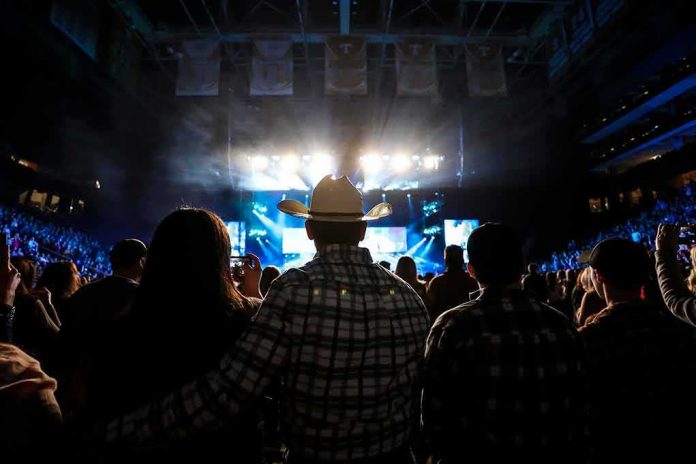
On a stage that doubles as a private workplace and a public square, clothing can function as a manifesto; at Gillette Stadium, Zach Bryan’s black “Free Palestine” shirt turned a country concert into a plainspoken act of political speech in a venue where that very phrase had just become contested.
At a Glance
- Zach Bryan wore a “Free Palestine” shirt during his Oct. 2 performance at Robert Kraft’s Gillette Stadium; multiple outlets corroborated it with concert footage.
- Members of Bryan’s band wore similar shirts, signaling a coordinated, on-stage statement rather than a one-off wardrobe quirk.
- The moment landed weeks after a Macklemore–Gillette dispute over pro-Palestinian advocacy, placing Bryan’s choice inside an active speech-versus-venue-power storyline.
- The shirt reportedly also included “An Appeal to Heaven” and a pine tree emblem, a layered message that travels across American protest traditions.
What Happened Onstage: A Clear, Coordinated Message
During the first of two Gillette Stadium shows in Foxborough, Massachusetts, Bryan performed in a black cutoff T-shirt reading “Free Palestine,” a message plainly legible in fan-shot video and photography aggregated by national outlets. The Friday-night date and the location are consistent across reports; coverage by Billboard and NBC News aligns on the wording visible on stage, and local CBS reporting describes additional text—“An Appeal to Heaven”—beneath the main slogan alongside a pine tree motif, a symbol with Revolutionary War lineage later repurposed in varied American protest idioms. Accounts also describe band members in similar shirts, underscoring that this was not an incidental garment but a coordinated, visible statement carried across the ensemble.
There was no speechifying from the mic, no mid-set manifesto—just the image, persistent and inescapable, doing its work. In live music, that is how many messages travel: through optics designed to be captured by phones and distributed at scale. The result is often more indelible than a paragraph of stage banter, because a picture persists in feeds long after any monologue dissolves in crowd noise.
Why That Stage, Why That Night: The Macklemore Precedent
The gesture resonated because of where it landed. In the weeks before Bryan’s show, Gillette Stadium and its owner, Robert Kraft, were at the center of a fast-moving dispute that began after Macklemore urged crowds to “Free Palestine” and criticized U.S. policy from major stages. Kraft publicly argued that Macklemore’s planned appearance at Gillette would cross a line for the venue; the booking unraveled, with explanations differing on whether Kraft’s stance triggered a broader refusal by venues or enforced a venue-specific ban. Either way, the core dynamic was unmistakable: a powerful stadium owner signaling that certain political speech would not be welcome on his stage.
This is a classic modern entertainment collision: artists using a mass platform for political expression inside a space controlled by private actors who manage risk, brand, and customer comfort. First Amendment doctrine is often invoked rhetorically here, but the law is clear: privately owned venues are not state actors and generally are not obligated to host speech they reject. The real battleground is practical power—who sets the terms of expression when a culture-scale platform is, in fact, a leased workplace with gatekeepers and contractual controls. Bryan’s shirt lived precisely in that seam.
How These Flashpoints Work: The Optics, The Owners, The Audience
Concerts concentrate attention. Forty or sixty thousand people in a stadium, millions more via social media highlights, and a few seconds of symbolism become disproportionately consequential. That asymmetry gives artists leverage: a shirt or backdrop can reframe the evening’s meaning without disrupting the set. Venue operators, in turn, worry about sponsor relations, security posture, reputational risk, and—especially with highly polarized slogans—the potential for protests to spill from digital to physical space. The politics are inseparable from production logistics and liability management.
“Free Palestine” exemplifies a high-conflict signifier. To supporters, it communicates solidarity with a people under occupation and a call for civil and human rights; to detractors, it can read as a denial of Israel’s legitimacy or a gateway to antisemitic rhetoric. That semantic volatility is why the phrase keeps generating venue-level controversy—and why artists who adopt it know it will travel. Bryan’s choice drew instant interpretation not just as pro-Palestinian solidarity but as a pointed gesture in Kraft’s house, a reading amplified by the recent Macklemore episode and by the fact that several of Bryan’s bandmates mirrored the visual message.
The Shirt’s Second Line: “An Appeal to Heaven”
One detail merits careful parsing: reports indicate the shirt also carried the line “An Appeal to Heaven” with a pine tree emblem. Historically, that phrase appears on a Revolutionary-era flag used by colonial naval forces; in recent years it has been reappropriated across disparate American movements as a compressed claim that when earthly remedies fail, justice must be sought at a higher register—moral, legal, divine, or democratic. Pairing that historical slogan with “Free Palestine” fuses a local, American grammar of liberty with an international cause. The juxtaposition reframes the shirt less as a transient political slogan and more as an argument about first principles—rights, self-determination, and the legitimacy of dissent in powerful spaces.
Whether Bryan intended that interpretive bridge, the combination travels that way in American iconography. It also blunts an easy caricature of the message as foreign or fringe; the pine tree drags the debate back onto ground Americans know well—their own contested inheritance of protest and patriotism.
Intent, Evidence, and What We Actually Know
There is a meaningful difference between what we can see and what we can infer. The public record established by reputable outlets and corroborated by video is strong on the facts: shirt text, venue, date, and ensemble participation. Bryan did not pause to explain from the stage, and as of those reports he had not put out a statement detailing motive or target, which is why newsrooms framed the act through the immediate context of Kraft and the Macklemore dispute. That contextual link is reasonable given timing and place, but it remains interpretive. The load-bearing fact remains the visible message on the most high-profile stage in New England football and pop culture.
In an era when a three-second clip can define a night, clarity about the evidentiary floor matters. Here, the floor is sturdy: multiple independent outlets citing the same visible facts; locally produced broadcast segments that slow down and annotate the imagery; and agreement on logistics—Friday night, first of two shows, in Foxborough. Read that as settled. It’s the meaning that audiences will continue to contest, and that contest is the point of public speech on a stage.
Zach Bryan wore a “Free Palestine” shirt during his concert at Gillette Stadium in Massachusetts, with members of his band also wearing Palestine themed clothing.
Attn.@palestine @IsraelArabic @netanyahu @Israel @gidonsaar @IDF @KnessetIL @Isaac_Herzog @IsraeliPM @IsraeliPM_heb pic.twitter.com/ZnAVw3n8gq— George Chamoun (@georgechamoun45) October 4, 2026
What It Means Going Forward: Stages as Speech Platforms
Expect more of this. Stadiums are among the last unifying spectacles in American life; they are also highly managed, privately controlled environments. That friction guarantees recurring flashpoints whenever artists carry polarizing messages into these spaces. For artists with enough draw to sell out stadiums, the calculus increasingly favors speaking anyway: the upside in authenticity and connection with a mission-aligned audience can outweigh venue displeasure, especially when the message is simple, legible, and photogenic. For venue owners, the risk calculus will keep trending in the other direction: reputational blowback now cuts both ways—punishing explicit suppression as well as tolerance of speech some find offensive. The Macklemore story showed how pressure can move backstage; Bryan’s night showed how visible defiance can move front-of-house. Both are now baked into how the business of spectacle works.
Sources:
facebook.com, edition.cnn.com, aljazeera.com, thewrap.com, cbsnews.com