

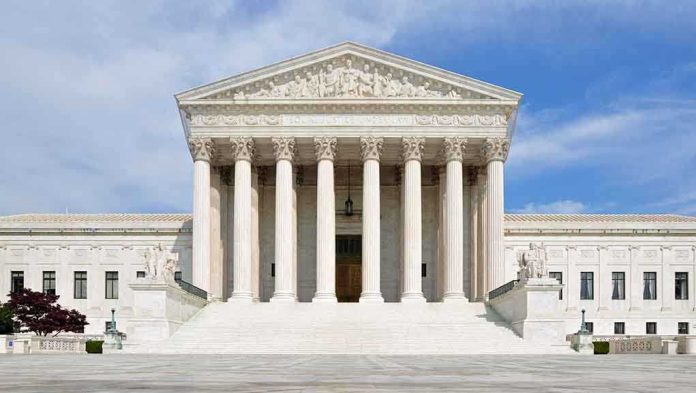
The Supreme Court ruled that government workers cannot be sued for personal damages under a federal funding law unless they clearly agreed to it — a win for limited government and due process, and a direct rebuttal to Justice Jackson’s broader view of liability.
Story Highlights
- Supreme Court held personal liability under Spending Clause laws requires knowing consent.
- Justice Neil Gorsuch wrote the opinion; Justice Ketanji Brown Jackson dissented.
- Court said individual officers never agreed to face damages under RLUIPA.
- Ruling aligns with years of circuit decisions rejecting personal-capacity damages.
What The Court Actually Decided In Landor
Justice Neil Gorsuch, writing for the Court, said people cannot be held personally liable under a federal funding law unless they knowingly and voluntarily agreed to that risk. The Court applied contract rules. If you did not sign the deal, you do not answer a breach claim. The prison system took federal money and accepted conditions. The officers did not. So the lawsuit for personal damages against the guards could not move forward under the Religious Land Use and Institutionalized Persons Act.
The Court grounded the result in the Spending Clause. Congress may attach strings to federal dollars, but those strings bind the entity that takes the money. Personal lawsuits are different. They require consent by the person who will be sued. The opinion stressed that the normal penalty for breaking funding conditions is the loss of funds, not surprise personal exposure. That is why the Court required clear agreement before any personal-capacity damages claim may proceed.
Why Justice Jackson Objected — And Why It Did Not Carry The Day
Justice Ketanji Brown Jackson’s dissent argued that the consent rule lacks firm support in the Constitution’s text and conflicts with past cases. She urged that identical language in the Religious Freedom Restoration Act allowed damages against officials, so this statute should do the same. The majority was not persuaded. The key difference is that this law rests on spending conditions to which only the state agency agreed, not the individual officers who never took on that personal risk.
Her position also faced a wall of lower-court precedent. Ten appeals courts had already rejected personal-capacity damages under the prison provision at issue. The United States Court of Appeals for the Fifth Circuit reached the same outcome, while sharply condemning the treatment the inmate reported. The Supreme Court’s ruling followed this settled line, confirming that individual officers are not personally liable without clear consent to be sued.
How The Ruling Protects Fair Notice And Limited Government
The decision protects a basic fairness rule: government cannot spring personal lawsuits on workers who never agreed to face them. The opinion treats federal funding laws like contracts. The state agency takes the money and the strings. Its employees do their jobs, but they did not sign away personal assets. The Court said that if Congress wants extra penalties, like personal damages, it must set out a path that secures knowing consent from the people who would face those suits.
Religious liberty remains protected. The statute still allows orders to stop ongoing violations and to change bad policies. But personal damages against guards require consent that is not present here. Some advocates say this limits accountability. The majority answered that Congress controls the purse and can cut funds or draft new, clear terms. If lawmakers want personal liability, they can write it plainly and require actual agreement from individuals before it attaches.
What This Means Next For States, Workers, And People Of Faith
State agencies that accept federal dollars must still respect religious exercise behind bars. Leaders should update training, tighten policies, and enforce discipline when rights are violated. Workers gain clarity that they will not face surprise personal lawsuits under spending laws they never agreed to. People of faith can still seek court orders to stop unlawful burdens on practice and to secure changes that prevent repeat harm. If more remedies are needed, Congress holds the pen.
Sources:
reason.com, en.wikipedia.org, becketfund.org, supremecourt.gov, theusconstitution.org, facebook.com