

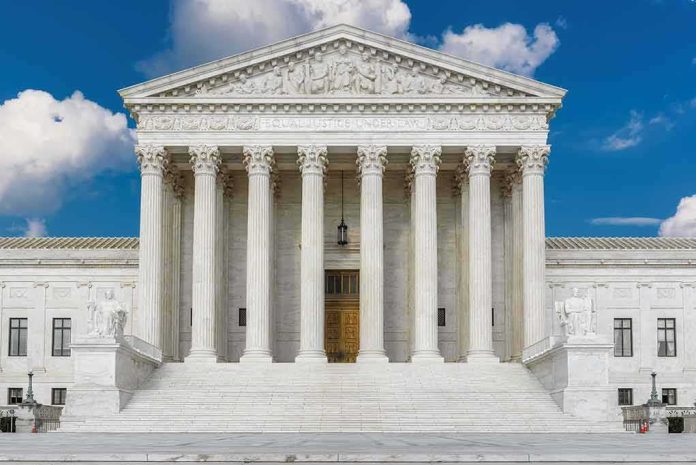
A new court fight over the abortion pill now threatens to pull power away from pro-life states and hand it back to unelected federal judges and career bureaucrats.
Story Snapshot
- A federal appeals court backed nationwide limits on abortion pills, but the Supreme Court quickly stepped in and hit pause.
- Louisiana and other pro-life states argue that mail-order abortion drugs gut their own state bans and protections.[4]
- Abortion advocates want federal courts and the Food and Drug Administration (FDA) to override state laws and restore easy, coast-to-coast pill access.[1][2]
- The Supreme Court’s short-term orders show how abortion policy keeps getting dragged back into Washington, even after Roe v. Wade fell.[3][5]
How We Got From “Leave It to the States” to a New Federal Abortion Battle
After the Supreme Court overturned Roe v. Wade in 2022, many Americans understood that abortion decisions were going back where they belong: to the states and their voters. Pro-life states like Louisiana passed strong protections for unborn children, including bans on most abortions within their borders.[4] But abortion activists quickly shifted tactics. They began using federal courts and federal drug rules to keep abortion pills flowing nationwide, even into states that passed clear pro-life laws.[3]
Mifepristone, the main abortion pill, became the center of this new fight. The Food and Drug Administration first approved it years ago, then under President Joe Biden relaxed rules so women could get it by mail, telehealth, and at regular pharmacies.[1][4] That move let abortion groups work around state bans by shipping pills into pro-life states, using the mail and online doctor visits instead of local clinics. Pro-life doctors and states argue this undercuts both state law and basic medical safeguards.[3]
Louisiana’s Case and the Fifth Circuit’s Nationwide Restrictions
Louisiana sued the Food and Drug Administration, arguing that letting abortion pills be mailed into a state that bans abortion makes those state laws almost meaningless.[4] In May 2026, the United States Court of Appeals for the Fifth Circuit sided with Louisiana and ordered strong nationwide limits on mifepristone while the case goes forward.[1] The court’s order would have forced women to pick up the drug in person at a clinic instead of by mail or at a local pharmacy.[1][4]
The Fifth Circuit ruling was a big win for pro-life advocates who say abortion pills should not be treated like an online shopping item. The court’s decision pushed back on the Food and Drug Administration’s 2021 choice to drop in-person rules and allow wide mail-order use of the drug.[1] Abortion-rights groups responded by warning that the decision could “upend” how abortion and miscarriage care are delivered across the country and pressed the Supreme Court to step in fast.[1][2]
The Supreme Court Steps In and Keeps Abortion Pills in the Mail—for Now
Within days, the Supreme Court issued an emergency order that temporarily blocked the Fifth Circuit’s restrictions and allowed mail-order mifepristone to continue, at least for a short time.[2][3] Justice Samuel Alito signed an order that restored the Food and Drug Administration’s looser rules while the justices review the legal issues.[3] That means, for the moment, women can still get abortion pills at pharmacies or through the mail without an in-person doctor visit, even in this new phase of the lawsuit.[3][5]
This is not the first time the high court has stepped into mifepristone fights. In 2024, the Supreme Court threw out a major challenge by pro-life doctors on “standing” grounds, saying they were not the right parties to bring that case. That decision left the Food and Drug Administration’s rules in place and signaled that the court might avoid big rulings on abortion pills by focusing on narrow legal questions. The new Louisiana case tests whether states, not private doctors, have a stronger claim.[3][4]
What This Means for States’ Rights, Federal Power, and Pro-Life Voters
These lawsuits are about more than one drug. They are about who sets the rules for life, health, and family in America. Pro-life states argue they passed clear laws to protect unborn children and support mothers, and that federal agencies and judges should not be able to reopen abortion access by mail from Washington.[3][4] Abortion advocates openly seek nationwide court orders that would override state bans and guarantee pill access even where voters chose strong pro-life protections.[2][5]
For conservatives, the pattern is familiar. When the left cannot win in state legislatures, it runs to friendly courts and federal regulators. Now, even after Roe fell, federal judges are again deciding how far abortion pills can be shipped, who can prescribe them, and whether state bans really mean what they say.[3] As these cases move forward, pro-life Americans will need to watch closely. The outcome will shape not only abortion policy, but also the balance of power between states, federal agencies, and the Supreme Court itself.
Sources:
[1] Web – So Much for Leaving Abortion Up to the States
[2] Web – Alliance for Hippocratic Medicine v. FDA
[3] Web – The Court Cases Targeting Mifepristone/Medication Abortion
[4] Web – Mifepristone Litigation and Federal Action Tracker – UCLA Law
[5] Web – Trump Administration Responds to Lawsuit Seeking Immediate …